| Journal of Clinical Question, 2024, Vol. 1, No. 3, 89–97 https://doi.org/10.69854/jcq.2024.0012 Advance access publication date 12 November 2024 |
 |
Meta-Analysis
The Effectiveness and Safety of Adjuvant Therapy with t-PA in Acute Ischemic Stroke: A Systematic Review and Network Meta-Analysis
1Department of Neurology, Henan Sanbo Brain Hospital, Henan, China.
2Department of Neurosurgery, Capital Medical University Sanbo Brain Hospital, Beijing, China.
3Department of Neurosurgery, Osaka Metropolitan University Hospital, Osaka, Japan.
*Corresponding Author: e-mail: toshiyuki1986.331.24ser@gmail.com
Submitted: October 05, 2024 Accepted: November 11, 2024
Clinical Question Box
What is the effectiveness and safety of adjuvant therapy with t-PA in acute ischemic stroke?
There is limited evidence supporting the use of tirofiban plus t-PA in acute ischemic stroke, showing a statistically significant improvement in functional recovery, as measured by the modified Rankin Scale, without an increased risk of mortality. In contrast, the use of eptifibatide or argatroban as adjunctive therapies with t-PA is not recommended, as neither demonstrated a significant improvement in functional recovery. Furthermore, argatroban may potentially increase the risk of mortality.
Abstract
Introduction: Acute ischemic stroke (AIS) is a leading cause of disability and death worldwide. While tissue plasminogen activator (t-PA) remains a cornerstone of treatment, its efficacy is limited by risks such as intracranial hemorrhage (ICH). The current systematic review and network meta-analysis aimed to evaluate the effectiveness and safety of adjuvant antithrombotic therapies combined with t-PA in AIS. Methods: A systematic search of multiple databases was conducted to identify prospective clinical trials that compared the efficacy and safety of tirofiban, eptifibatide, and argatroban in adjunctive therapies to t-PA in AIS. The primary outcomes included functional recovery, measured by a modified Rankin Scale (mRS) score of 0–1 at 90 days, and safety outcomes such as ICH and mortality. Results: Eight clinical trials involving 2,074 patients were included. Tirofiban plus t-PA significantly improved functional recovery at 90 days compared to t-PA alone (odds ratio [OR] 2.23, 95% confidence interval [CI]: 1.08–4.60). In contrast, neither argatroban nor eptifibatide significantly improved functional recovery, with ORs of 0.92 (95% CI: 0.48–1.78) and 0.63 (95% CI: 0.32–1.23), respectively. Argatroban was associated with an increased risk of mortality (OR 3.28, 95% CI: 1.52–7.07), whereas tirofiban and eptifibatide did not significantly increase mortality risk. None of the studies showed a statistically significant difference in the risk of ICH. Conclusion: Tirofiban, as an adjunct to t-PA, demonstrated superior efficacy and safety, suggesting its viability in AIS management. Meanwhile, the association of argatroban with increased ICH and mortality raises concerns about its use.
Keywords: Acute ischemic stroke, adjuvant therapy, t-PA, tirofiban, eptifibatide, argatroban.
1. Introduction
Acute ischemic stroke (AIS), being one of the leading causes of both disability and death, presents a major global health challenge.1 Over 12.2 million individuals experience a new stroke annually. Worldwide, nearly one in four adults over the age of 25 is expected to suffer from a stroke during their lifetime, with ischemic strokes accounting for approximately 85% of all cases.2 Of those affected, five million individuals succumb to the condition, while another five million are left with long-term disabilities, creating significant burdens on families and communities.3 AIS occurs when blood flow to a region of the brain is obstructed or decreased, leading to tissue injury from a lack of oxygen.4 The resulting brain injury can cause various long-term impairments, including movement difficulties, speech issues, cognitive challenges, and emotional disturbances, all of which can severely affect the quality of life.5 Stroke survivors frequently require prolonged rehabilitation and continuous healthcare, putting a considerable financial strain on healthcare systems worldwide.6 As the global population ages and risk factors such as high blood pressure, diabetes, and obesity become more prevalent, the incidence of AIS continues to grow, highlighting the urgent need for clinical research and new treatment approaches.7
The primary aim of AIS treatment is to restore blood flow to the brain swiftly, minimizing permanent damage and improving recovery prospects. For years, intravenous thrombolytic treatment has been pivotal in AIS management, particularly with tissue-type plasminogen activator (t-PA).8 Medications such as alteplase and tenecteplase help dissolve clots and re-establish blood flow to affected brain regions.9 Administering these agents within a strict therapeutic window—generally within 4.5 hours of symptom onset—can improve recovery.10 The effectiveness of thrombolysis depends on prompt diagnosis and immediate treatment, emphasizing the need for quick action to limit brain injury.11 Nevertheless, t-PA poses considerable risks, such as an increased risk of hemorrhagic complications and potentially worsening outcomes.12 Consequently, there is ongoing interest in exploring additional therapies to improve the effectiveness and safety of thrombolytic approaches.
To enhance the effectiveness of t-PA and minimize the risks associated with thrombolytic therapy, researchers have explored various supplementary treatments, including antithrombotic drugs like tirofiban, eptifibatide, abciximab, and argatroban.13 Tirofiban, eptifibatide, and abciximab function as glycoprotein IIb/IIIa inhibitors preventing the final stage of platelet aggregation, while argatroban acts as a direct thrombin inhibitor to help prevent new clot formation.14,15 Early preclinical and clinical studies indicate that using these antithrombotic agents in conjunction with t-PA may produce synergistic effects, enhancing reperfusion outcomes and decreasing the likelihood of re-occlusion, which is a frequent complication after successful thrombolysis.16
Although combining antithrombotic agents with t-PA offers theoretical advantages, clinical trials and observational studies have produced inconsistent results, particularly for argatroban.17,18 Similarly, eptifibatide demonstrated possible safety and efficacy in early-phase trials but was ultimately found ineffective in a larger study.19,20 In contrast, tirofiban consistently showed efficacy across studies.21–23 Given these conflicting findings and the lack of direct comparisons, the current network meta-analysis (NMA) aims to systematically assess the effectiveness and safety of various antithrombotic agents as adjunctive therapies to t-PA in the treatment of AIS. By synthesizing data from randomized controlled trials (RCTs), this study seeks to provide a comprehensive evaluation of the relative performance of antithrombotic drugs when used in combination with t-PA.
2. Methods
2.1 Overview
This study adheres to the Preferred Reporting Items for Systematic Reviews and Meta-Analyses (PRISMA) guidelines for conducting and reporting network meta-analyses.24 Only randomized controlled trials (RCTs) published in English and available in full-text format were considered for this analysis. This network meta-analysis was registered in the UMIN Clinical Trials Registry under the identifier UMIN000056077.25
2.2 Search Strategy
We conducted a comprehensive literature search across major databases, including PubMed, Web of Science, Cochrane Library, and Embase, to identify relevant clinical trials published until September 27, 2024. The search strategy employed terms related to AIS, thrombolysis, and antithrombotic agents. Specifically, the following terms were used: tissue-type plasminogen activator OR t-PA OR thrombolysis OR monteplase OR alteplase OR tenecteplase AND acute ischemic stroke, targeting patients with AIS who received t-PA treatment. Additionally, we used the terms tirofiban, eptifibatide, abciximab, and argatroban to identify studies on antithrombotic agents used in add-on therapies with t-PA.
2.3 Eligibility Criteria
For the meta-analysis, we included studies that (1) involved adult patients diagnosed with acute ischemic stroke, (2) evaluated the efficacy of t-PA in combination with antithrombotic agents, and (3) reported relevant clinical outcomes, such as mortality, functional recovery, neurological assessment, and safety. We excluded studies in which (1) thrombolysis was performed by thrombectomy or catheter, (2) a retrospective approach was employed, or (3) relevant clinical outcomes were not reported.
2.4 Data Extraction
Two independent reviewers screened the titles and abstracts of all identified studies for eligibility. Full-text articles were retrieved for studies that met the inclusion criteria. Discrepancies between the reviewers were resolved through discussion or, if necessary, consultation with a third reviewer. A flow diagram of the study selection process is provided following PRISMA guidelines. From each included study, data were extracted on the following variables: study characteristics (author, year of publication, study design), participant demographics (age and gender), intervention details, and clinical outcomes. When necessary, the corresponding authors were contacted for clarification or additional data.
2.5 Outcomes
The primary outcome was achieving a modified Rankin Scale (mRS) score of 0 to 1, indicating no significant disability, at 90 days post-admission. Secondary outcomes included the incidence of any reported intracerebral hemorrhage (ICH) events within the first seven days of treatment and all-cause mortality during the study period. These outcomes were chosen to capture both functional recovery and safety-related adverse events following intervention.
2.6 Statistical Analysis
An NMA was performed using a random-effects model to estimate the relative effects of adjunctive antithrombotic therapies in combination with t-PA. The results are presented as odds ratios (ORs) with 95% confidence intervals (CIs) for binary outcomes. Heterogeneity among the studies was assessed using the I2 statistic, with values greater than 50% indicating substantial heterogeneity. Inconsistency between direct and indirect comparisons was evaluated using the node-splitting method. Sensitivity analyses were performed to assess the robustness of the findings by excluding studies with a high risk of bias and using alternative statistical models. The risk of bias in the included studies was assessed using the Cochrane Collaboration’s tool for randomized controlled trials. The Grading of Recommendations Assessment, Development, and Evaluation (GRADE) approach assessed the evidence level.
3. Results
3.1 Study Selection and Characteristics
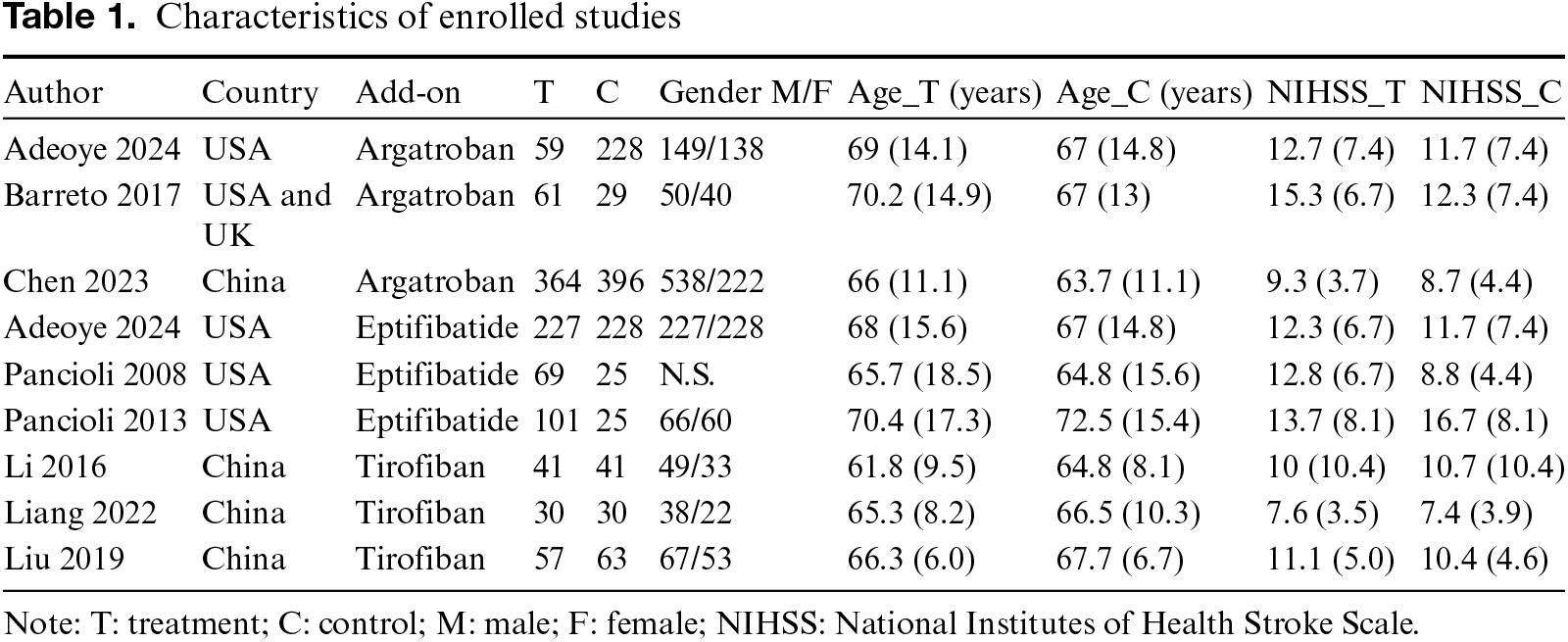
A total of 1,259 studies were retrieved from four databases. Duplicate articles were removed by software, and the first and secondary screenings were excluded, with 173, 942, and 135 studies at each step, respectively. Finally, eight studies were included in the final analysis, comprising 2,074 patients.17,19–23,26–28 The baseline characteristics of the included studies are summarized in Table 1. Four studies were conducted in China, three in the USA, and one in both the USA and the UK. Tirofiban, eptifibatide, abciximab, and argatroban were investigated as add-on agents. However, no RCT was available for abciximab. The studies varied in sample size, ranging from 30 to 396 participants. The average age of participants in the treatment group ranged from 61.8 to 70.4 years, with a relatively equal gender distribution in most studies. Most studies included patients with a baseline NIHSS score of 10 or higher; however, one study evaluated add-on therapy in patients with an NIHSS score of around 7.4.
3.2 Functional Recovery of mRS
The network graph of studies included in the efficacy analysis is shown in Fig. 1A, which assesses the mRS scores of 0 to 1 at 90 days. Tirofiban plus t-PA significantly improved functional recovery compared with t-PA alone, with an OR of 2.23 (95% CI: 1.08–4.60). Argatroban plus t-PA and eptifibatide plus t-PA did not show significant improvements over t-PA alone, with ORs of 0.92 (95% CI: 0.48–1.78) and 0.63 (95% CI: 0.32–1.23), respectively (Fig. 2A). The NMA showed that tirofiban plus t-PA was superior to eptifibatide plus t-PA, with an OR of 3.35 (95% CI: 1.32–9.55), but not superior to argatroban plus t-PA, which had an OR of 2.41 (95% CI: 0.91–6.40) (Table 2). The rank of effectiveness, as assessed by mRS after 1,000 simulations for each treatment, was as follows: tirofiban plus t-PA, followed by t-PA, argatroban plus t-PA, and eptifibatide plus t-PA (Fig. 3A).
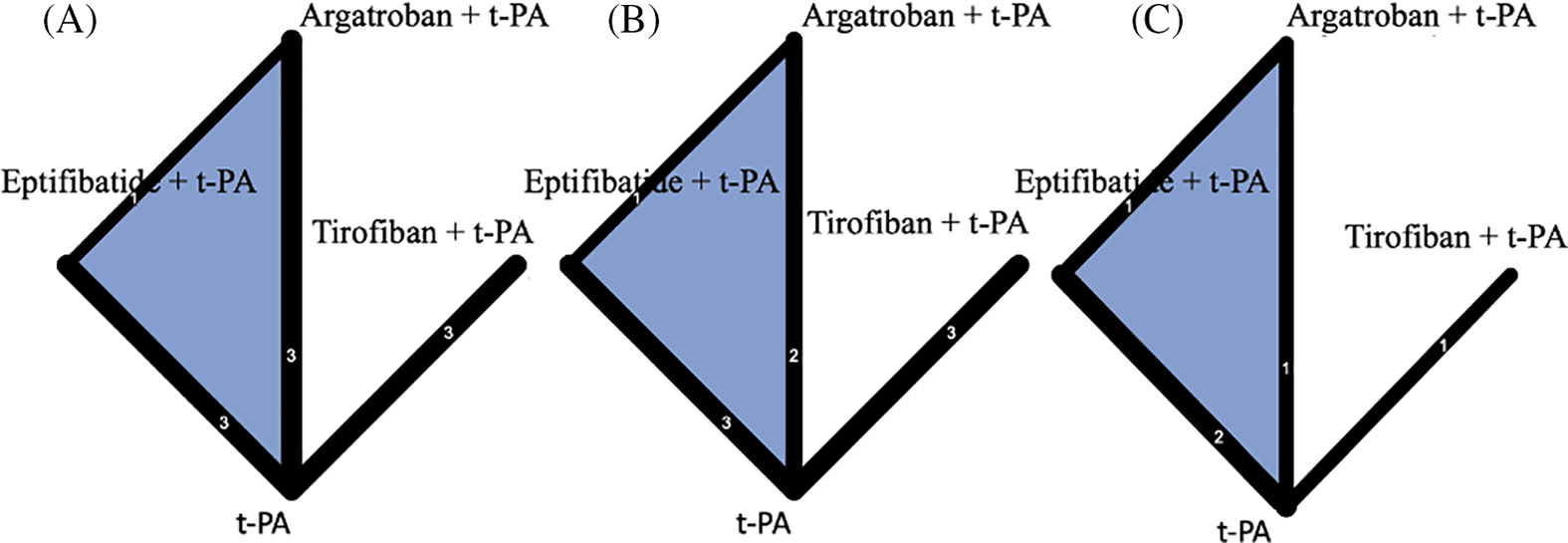
Figure 1. Network graph of included studies for outcomes. (A) Network graph for the effectiveness of modified Rankin Scale; (B) network graph for the safety of intracerebral hemorrhage; (C) network graph for the safety of mortality.
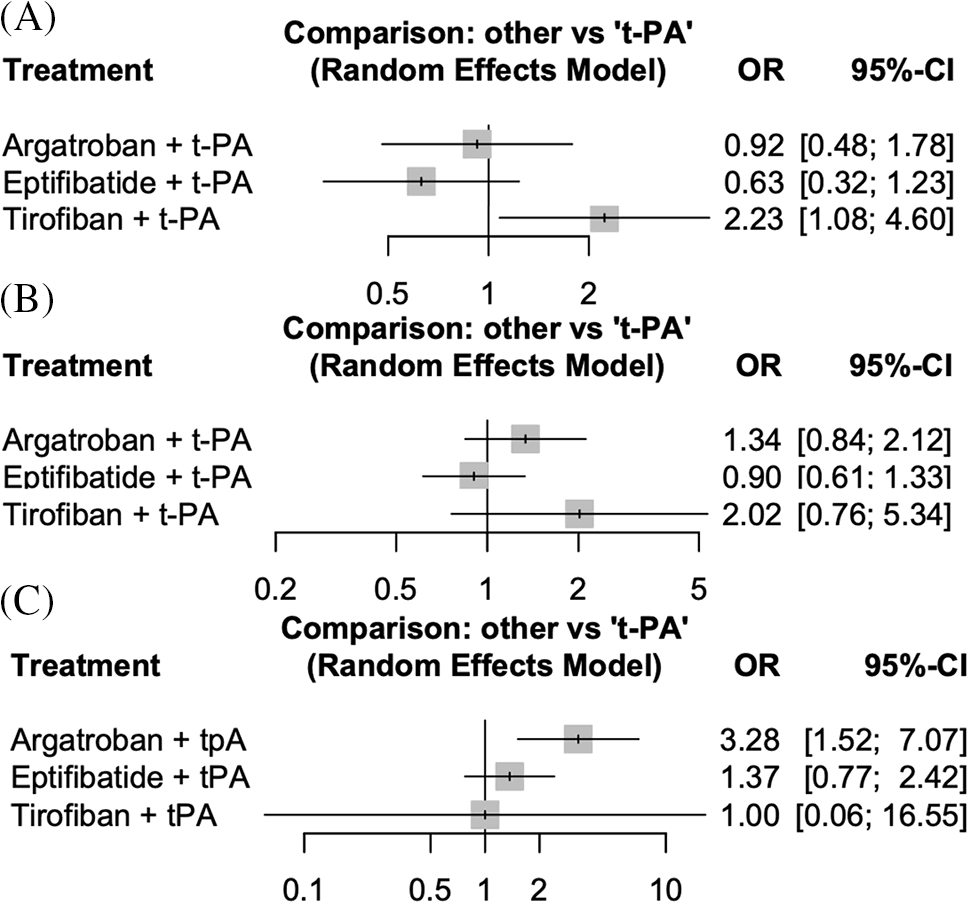
Figure 2. A pooled analysis of the add-on efficiency and safety in acute ischemic stroke. (A) pooled analysis for the effectiveness of modified Rankin Scale; (B) pooled analysis for the safety of intracerebral hemorrhage; (C) pooled analysis for the safety of mortality. OR: odds ratio, CI: confidence interval.

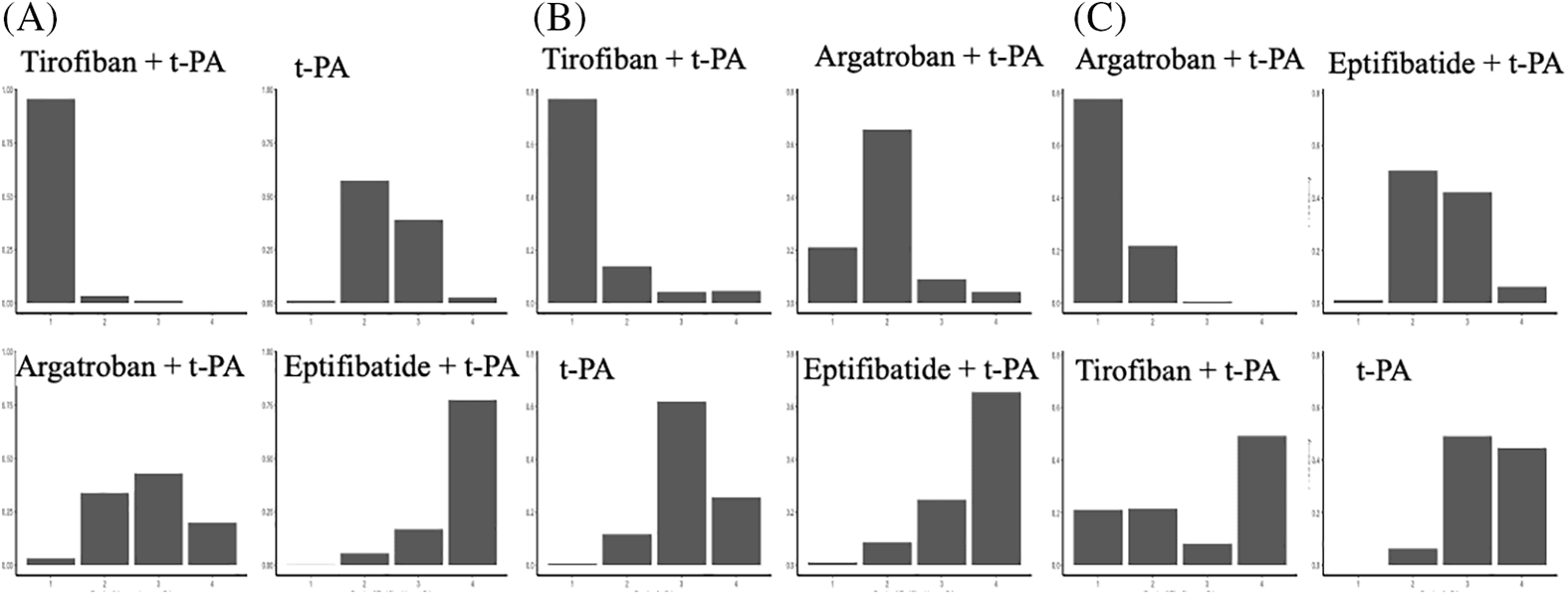
Figure 3. Rank of the possibility based on 1000 simulations for each treatment. (A) Pooled analysis for the effectiveness of modified Rankin Scale; (B) pooled analysis for the safety of intracerebral hemorrhage; (C) pooled analysis for the risk of mortality.
3.3 Safety by ICH
The network graph of studies included in the safety analysis is shown in Fig. 1B, which assesses any kind of ICH. Argatroban plus t-PA and tirofiban plus t-PA showed an increased trend risk of ICH compared with t-PA alone, with an OR of 2.02 (95% CI: 0.76–5.34) and 1.34 (95% CI: 0.84–2.12), respectively, eptifibatide plus t-PA did not show a significant increase in the risk of ICH over t-PA alone, with ORs of 1.37 (95% CI: 0.77–2.42) (Fig. 2B). The NMA showed that none of the three add-on agents were superior in terms of ICH risk (Table S1). The rank of safety, as assessed by ICH risk after 1,000 simulations for each treatment, was as follows: tirofiban plus t-PA, followed by argatroban plus t-PA, t-PA, and eptifibatide plus t-PA (Fig. 3B).
3.4 Mortality
The network graph of studies included in the safety analysis is shown in Fig. 1C, which assesses mortality. Argatroban plus t-PA significantly increased the risk of mortality compared with t-PA alone, with an OR of 3.28 (95% CI: 1.52–7.07). Tirofiban plus t-PA and eptifibatide plus t-PA did not show a significantly increased risk of mortality over t-PA alone, with ORs of 1.37 (95% CI: 0.77–2.42) and 1.00 (95% CI: 0.06–16.55), respectively (Fig. 2C). The NMA showed that argatroban plus t-PA was inferior to eptifibatide plus t-PA and t-PA, with increased ORs of 2.4 (95% CI: 1.15–4.98) and 3.28 (95% CI: 1.52–7.07), respectively, for mortality (Table S2), but no inferior to tirofiban plus t-PA, with OR of 3.28 (95% CI: 0.18–60.14). The rank of mortality risk after 1,000 simulations for each treatment was the following: argatroban plus t-PA, eptifibatide plus t-PA, tirofiban plus t-PA and t-PA (Fig. 3C).
3.5 Heterogeneity, Bias, and Consistency Analysis
Moderate heterogeneity was observed among the included studies, with a high I2 value of 66.6% (95% CI, 32.4–83.5), while heterogeneity for both ICH and mortality was 0%. However, there was a relatively high risk of bias in studies from China due to open-label study design (Fig. S2). Inconsistency testing using the node-splitting method revealed no significant discrepancies between direct and indirect comparisons, indicating the reliability of the network estimates. Fixed-effect models were also employed, and the results were consistent with those from random-effects models.
4. Discussion
This NMA evaluated the efficacy and safety of add-on antithrombotic therapies combined with t-PA in patients with AIS. Tirofiban, when used alongside t-PA, significantly improved functional recovery at 90 days, as measured by mRS scores, compared to t-PA alone. In contrast, neither argatroban nor eptifibatide as add-on agents demonstrated statistically significant benefits in functional recovery.29 In terms of safety, both tirofiban plus t-PA and argatroban plus t-PA showed a trend toward an increased risk of ICH compared to t-PA alone. While argatroban plus t-PA was also associated with a higher risk of mortality. Based on the treatment hierarchy, tirofiban was ranked as the most effective and relatively safer agent, while argatroban plus t-PA and eptifibatide plus t-PA were ranked lower in efficacy and linked with higher mortality risks.
Despite the small scale and relatively high risk of bias in studies focusing on tirofiban, the findings are consistent with previous research suggesting that tirofiban may be a beneficial adjunctive therapy to t-PA in AIS.30 The lack of significant benefits with eptifibatide and argatroban aligns with earlier reports questioning their effectiveness in this setting.19,20 Although both argatroban and tirofiban potentially increase the risk of ICH, the elevated risks of mortality associated with argatroban reflect concerns raised in prior safety evaluations. This analysis offers comparative data, further establishing tirofiban’s relative advantage over other antithrombotic therapies in stroke management.
This study’s findings have important clinical implications for the management of AIS. The superior efficacy and favorable safety profile of tirofiban suggest its possible use as a viable adjunctive therapy to t-PA, potentially improving functional outcomes without substantially increasing the risk of mortality.31,32 Given the critical importance of achieving functional recovery while minimizing adverse outcomes in stroke patients, these results highlight tirofiban as a promising candidate for further investigation in multi-center CRTs. The combination of thrombectomy or stenting with antithrombotic agents has shown promise in enhancing outcomes for patients with AIS.33,34 These interventional approaches, when paired with antithrombotic therapies, aim to improve vessel patency and reduce the risk of re-occlusion, ultimately promoting better neurological recovery. However, this combination also presents potential risks, particularly an increased likelihood of ICH, necessitating careful selection of antithrombotic agents and dosage. Emerging evidence suggests that specific agents, such as tirofiban, may offer a favorable balance of efficacy and safety when used adjunctively with these mechanical interventions.35
Despite these meaningful findings, several limitations of this study must be acknowledged. First, the total sample size for studies involving tirofiban or eptifibatide was under 400 cases, which introduces potential imprecision. Second, there was a high risk of selection, performance, and detection bias in tirofiban studies, which lowers the evidence level according to GRADE criteria. Unlike studies on other agents involving larger and more diverse sample sizes, these studies were also conducted exclusively within a Chinese population. The heterogeneity across studies may have impacted the pooled estimates. Third, this analysis specifically focused on the effectiveness and safety of adjunctive therapy to t-PA, so the effectiveness of the discussed medications in the context of thrombectomy or stenting was not addressed.
5. Conclusion
This network meta-analysis suggests that tirofiban plus t-PA may provide superior functional recovery with a favorable safety profile in patients with AIS compared to other add-on antithrombotic drugs. However, argatroban was associated with an increased risk of mortality. Further large-scale RCTs are needed to confirm these findings and investigate tirofiban’s potential as a standard adjunctive therapy in thrombolysis for AIS.
Acknowledgment
None.
Funding Source
This research was funded by Grants in Aid for Scientific Research. Grant number 20K17937.
Author Contributions
K.T. contributed to the study design and drafting. As principal investigators, X.Z. and M.Z. worked on the study search, quality check, data extraction, and analysis. K.T., X.Z., and M.Z. worked on data interpretation and the revision process. All authors have read the manuscript and agree with its content and data.
Data Availability Statement
The data supporting this study’s findings are available from the corresponding author upon reasonable request.
Ethical Statement
Institutional Review Board approval was waived due to the nature of the meta-analysis.
Conflicts of Interest
The authors report no conflicts of interest in this work.
Supplemental Information
Supplemental information for this article can be found online at https://sup.jclinque.com/api/articles/49/download-suppl.
References
[1] Luo Z, Shan S, Cao J, et al. Temporal trends in cross-country inequalities of stroke and subtypes burden from 1990 to 2021: a secondary analysis of the global burden of disease study 2021. EClinicalMedicine. October 2024;76:102829. doi:10.1016/j.eclinm.2024.102829.
[2] Feigin VL, Brainin M, Norrving B, et al. World Stroke Organization (WSO): global stroke fact sheet 2022. Int J Stroke. January 2022;17(1):18–29. doi:10.1177/17474930211065917.
[3] Bersano A, Gatti L. Pathophysiology and treatment of stroke: present status and future perspectives. Int J Mol Sci. October 3, 2023;24(19):14848. doi:10.3390/ijms241914848.
[4] Tadi P, Lui F, Budd LA. Acute Stroke (Nursing). In: StatPearls. Treasure Island (FL): StatPearls Publishing; August 17, 2023.
[5] Elendu C, Amaechi DC, Elendu TC, et al. Stroke and cognitive impairment: understanding the connection and managing symptoms. Ann Med Surg (Lond). December 2023;85(12):6057–6066. doi:10.1097/MS9.0000000000001441.
[6] Fernandes JB, Fernandes S, Domingos J, et al. Motivational strategies used by health care professionals in stroke survivors in rehabilitation: a scoping review of experimental studies. Front Med (Lausanne). 2024;11:1384414. doi:10.3389/fmed.2024.1384414.
[7] Dai B, Addai-Dansoh S, Nutakor JA, et al. The prevalence of hypertension and its associated risk factors among older adults in Ghana. Front Cardiovasc Med. 2022;9:990616. doi:10.3389/fcvm.2022.990616.
[8] Albers GW, Bates VE, Clark WM, et al. Intravenous tissue-type plasminogen activator for treatment of acute stroke: the Standard Treatment with Alteplase to Reverse Stroke (STARS) study. Jama. March 1, 2000;1(9):1145–1150. doi:10.1001/jama.283.9.1145.
[9] Zhu A, Rajendram P, Tseng E, et al. Alteplase or tenecteplase for thrombolysis in ischemic stroke: an illustrated review. Res Pract Thromb Haemost. August 2022;6(6):e12795. doi:10.1002/rth2.12795.
[10] Saceleanu VM, Toader C, Ples H, et al. Integrative approaches in acute ischemic stroke: from symptom recognition to future innovations. Biomedicines. September 23, 2023;11(10):2617. doi:10.3390/biomedicines11102617.
[11] Hasan TF, Hasan H, Kelley RE. Overview of acute ischemic stroke evaluation and management. Biomedicines. October 16, 2021;9(10):1486. doi:10.3390/biomedicines9101486.
[12] Sun J, Lam C, Christie L, et al. Risk factors of hemorrhagic transformation in acute ischaemic stroke: a systematic review and meta-analysis. Front Neurol. 2023;14:1079205. doi:10.3389/fneur.2023.1079205.
[13] Asadi H, Yan B, Dowling R, et al. Advances in medical revascularisation treatments in acute ischemic stroke. Thrombosis. 2014;2014:714218. doi:10.1155/2014/714218.
[14] Hasanpour M, Maleki S, Rezaee H, et al. Glycoprotein IIb/IIIa inhibitors in the treatment of thromboembolic events related to endovascular treatment of cerebral aneurysms-systematic review and meta-analysis. Neuroradiol J. April 2024;37(2):152–163. doi:10.1177/19714009231166090.
[15] Yoshida S, Kazekawa K, Kamatani K, et al. Neurological outcomes of flow-diverter stent placement for middle cerebral artery aneurysms, with reference to the effects of Argatroban on ischemic events: patient series. J Neurosurg Case Lessons. August 5, 2024;8(6):CASE24237. doi:10.3171/CASE24237.
[16] Liu JST, Ding Y, Schoenwaelder S, Liu X. Improving treatment for acute ischemic stroke-Clot busting innovation in the pipeline. Front Med Technol. 2022;4:946367. doi:10.3389/fmedt.2022.946367.
[17] Chen HS, Cui Y, Zhou ZH, et al. Effect of argatroban plus intravenous alteplase vs intravenous alteplase alone on neurologic function in patients with acute ischemic stroke: the ARAIS randomized clinical trial. Jama. February 28, 2023;329(8):640–650. doi:10.1001/jama.2023.0550.
[18] Berekashvili K, Soomro J, Shen L, et al. Safety and feasibility of argatroban, recombinant tissue plasminogen activator, and intra-arterial therapy in stroke (ARTSS-IA Study). J Stroke Cerebrovasc Dis. December 2018;27(12):3647–3651. doi:10.1016/j.jstrokecerebrovasdis.2018.08.036.
[19] Pancioli AM, Adeoye O, Schmit PA, et al. Combined approach to lysis utilizing eptifibatide and recombinant tissue plasminogen activator in acute ischemic stroke-enhanced regimen stroke trial. Stroke. September 2013;44(9):2381–2387. doi:10.1161/STROKEAHA.113.001059.
[20] Adeoye O, Broderick J, Derdeyn CP, et al. Adjunctive intravenous argatroban or eptifibatide for ischemic stroke. N Engl J Med. September 5, 2024;391(9):810–820. doi:10.1056/NEJMoa2314779.
[21] Li W, Lin L, Zhang M, et al. Safety and preliminary efficacy of early tirofiban treatment after alteplase in acute ischemic stroke patients. Stroke. October 2016;47(10):2649–2651. doi:10.1161/STROKEAHA.116.014413.
[22] Liang Z, Zhang J, Huang S, et al. Safety and efficacy of low-dose rt-PA with tirofiban to treat acute non-cardiogenic stroke: a single-center randomized controlled study. BMC Neurol. July 27, 2022;22(1):280. doi:10.1186/s12883-022-02808-w.
[23] Liu J, Shi Q, Sun Y, et al. Efficacy of tirofiban administered at different time points after intravenous thrombolytic therapy with alteplase in patients with acute ischemic stroke. J Stroke Cerebrovasc Dis. April 2019;28(4):1126–1132. doi:10.1016/j.jstrokecerebrovasdis.2018.12.044.
[24] Page MJ, McKenzie JE, Bossuyt PM, et al. The PRISMA, 2020 statement: an updated guideline for reporting systematic reviews. Syst Rev. March 29, 2021;10(1):89. doi:10.1186/s13643-021-01626-4.
[25] University hospital Medical Information Network Clinical Trials Registry. The effectiveness and safety of adjuvant therapy with t-PA in acute ischemic stroke. Published 2024. Accessed November 6, 2024. https://center6.umin.ac.jp/cgi-open-bin/ctr_e/ctr_view.cgi?recptno=R000064078.
[26] Barreto AD, Ford GA, Shen L, et al. Randomized, multicenter trial of ARTSS-2 (Argatroban with recombinant tissue plasminogen activator for acute stroke). Stroke. June 2017;48(6):1608–1616. doi:10.1161/strokeaha.117.016720.
[27] Du Y, Li Y, Duan Z, et al. The efficacy and safety of intravenous tirofiban in the treatment of acute ischemic stroke patients with early neurological deterioration. J Clin Pharm Ther. December 2022;47(12):2350–2359. doi:10.1111/jcpt.13816.
[28] Pancioli AM, Broderick J, Brott T, et al. The combined approach to lysis utilizing eptifibatide and rt-PA in acute ischemic stroke: the CLEAR stroke trial. Stroke. December 2008;39(12):3268–3276. doi:10.1161/STROKEAHA.108.517656.
[29] Cheng Y, Liu C, Li S, et al. Efficacy and safety of Argatroban in patients with acute ischemic stroke: a systematic review and meta-analysis. Front Neurol. 2024;15:1364895. doi:10.3389/fneur.2024.1364895.
[30] Zhu X, Guo Z, Tian L, et al. Efficacy and safety of tirofiban combined with endovascular therapy for basilar artery occlusion stroke due to large artery atherosclerosis. J Stroke Cerebrovasc Dis. February 2024;33(2):107526. doi:10.1016/j.jstrokecerebrovasdis.2023.107526.
[31] Sun Z, Huang S, Li W, et al. Preoperative and intraoperative tirofiban during endovascular thrombectomy in large vessel occlusion stroke due to large artery atherosclerosis. Eur J Neurol. October 2024;31(10):e16419. doi:10.1111/ene.16419.
[32] Su S, Bai X, Li Q, et al. Safety and efficacy of tirofiban combined with intravenous thrombolysis and endovascular treatment in acute large vessel occlusion stroke. Clin Neurol Neurosurg. September 2024;244(11):108463. doi:10.1016/j.clineuro.2024.108463.
[33] Garayzade R, Berlis A, Schiele S, et al. Efficacy and safety outcomes for acute ischemic stroke patients treated with intravenous infusion of tirofiban after emergent carotid artery stenting. Clinic Neuroradiol. March 1, 2024;34(1):163–172. doi:10.1007/s00062-023-01350-7.
[34] Da Ros V, Scaggiante J, Sallustio F, et al. Carotid stenting and mechanical thrombectomy in patients with acute ischemic stroke and tandem occlusions: antithrombotic treatment and functional outcome. AJNR Am J Neuroradiol. November 2020;41(11):2088–2093. doi:10.3174/ajnr.A6768.
[35] Guo YZ, Zhao ZW, Li SM, et al. Clinical efficacy and safety of tirofiban combined with conventional dual antiplatelet therapy in ACS patients undergoing PCI. Sci Rep. August 25, 2021;11(1):17144. doi:10.1038/s41598-021-96606-y.
 |
Copyright: © 2024 Zhen et al. This work is licensed under a Creative Commons Attribution 4.0 International License, which permits unrestricted use, distribution, and reproduction in any medium, provided the original work is properly cited. |