| Journal of Clinical Question. 2025; 2(5): e86 https://doi.org/10.69854/jcq.2025.0022 Advance access publication date 03 September 2025 |
 |
Meta-Analysis
Oral Antifibrotic Agents for the Treatment of Progressive Pulmonary Fibrosis: A Systematic Review and Network Meta-Analysis of Randomized Controlled Trials
Yoichi Tagami , Motoki Kawai, Ken Okamura, Hideya Kitamura*
Department of Respiratory Medicine, Kanagawa Cardiovascular and Respiratory Center, Yokohama, Japan.
*Corresponding Author: e-mail: kitamura.19056@kanagawa-pho.jp
Submitted: June 12, 2025 Accepted: September 2, 2025
Clinical Question Box
Is antifibrotic therapy recommended for patients with progressive pulmonary fibrosis (PPF)?
Antifibrotic therapy is advised for individuals diagnosed with PPF. The combination of nerandomilast with nintedanib, as well as nintedanib monotherapy, has demonstrated the most significant potential in reducing the decline in forced vital capacity, as evidenced by high-certainty evidence. Monotherapy with pirfenidone and nerandomilast has also exhibited effectiveness, albeit with moderate-certainty evidence. However, no treatment was found to significantly lower all-cause mortality or increase the risk of serious adverse events.
Abstract
Introduction: Progressive pulmonary fibrosis (PPF) is a form of interstitial lung disease characterized by irreversible fibrotic progression and deteriorating lung function. Although antifibrotic agents approved for idiopathic pulmonary fibrosis (IPF) are used in PPF, their comparative efficacy and safety remain unclear. Methods: A Bayesian network meta-analysis (NMA) was conducted following the Preferred Reporting Items for Systematic Reviews and Meta-Analyses NMA guidelines. Randomized controlled trials (RCTs) assessing oral antifibrotic agents, including nintedanib, pirfenidone, and nerandomilast, in PPF were identified from major databases up to May 2025. The outcomes assessed included changes in forced vital capacity (FVC), all-cause mortality, and serious adverse events (SAEs). Treatments were ranked using surface under the cumulative ranking curve values. Results: Four RCTs (n = 1,209) were included in the analysis. The combination of nintedanib with both low- and high-dose nerandomilast (NRD_LN and NRD_HN) demonstrated the greatest efficacy in reducing FVC decline compared to placebo, with mean differences (MDs) of 200 mL (95% confidence interval [CI]: 133–268) and 185 mL (95% CI: 117–253), respectively. Nintedanib monotherapy followed, with an MD of 107 mL (95% CI: 65–149). Combination therapies that included nerandomilast were more effective than either nerandomilast or nintedanib monotherapy but did not surpass the efficacy of pirfenidone. None of the treatments significantly reduced all-cause mortality or increased SAEs, and no regimen demonstrated a clear safety advantage. Pirfenidone demonstrated the lowest odds ratios (ORs) for mortality (OR = 0.29; 95% CI: 0.03–2.30) and SAEs (OR = 0.69; 95% CI: 0.35–1.40), although these differences were not statistically significant. Conclusion: Antifibrotic therapies demonstrated efficacy in slowing FVC decline among patients with PPF, with nintedanib, either used alone or in combination with nerandomilast, showing the highest efficacy. These findings support the use of antifibrotics in PPF and emphasize the need for future head-to-head trials and long-term outcome assessments.
Keywords: Progressive pulmonary fibrosis, antifibrotic therapy, nintedanib, pirfenidone, nerandomilast, network meta-analysis
Introduction
Interstitial lung disease (ILD) refers to a wide array of lung disorders characterized by inflammation and fibrosis of the lung interstitium.1 The causes of ILD include connective tissue diseases, drug-induced lung injury, hypersensitivity pneumonitis, and occupational exposures such as pneumoconiosis. Among these, idiopathic interstitial pneumonias are ILDs with no identifiable cause, with idiopathic pulmonary fibrosis (IPF) being the most common subtype.2 IPF is associated with a poor prognosis due to the progressive nature of fibrosis, which ultimately results in respiratory failure. It has been acknowledged that ILDs not classified as IPF may also demonstrate similar clinical characteristics, such as worsening fibrosis despite standard treatment. This recognition has led to the development of concepts like progressive fibrosing ILD (PF-ILD).3 Since 2022, the term progressive pulmonary fibrosis (PPF) has been adopted to describe this clinical phenotype, which is characterized by relentless fibrotic progression, worsening respiratory symptoms, and declining lung function, regardless of the underlying ILD subtype.4
PPF is increasingly recognized as a major cause of respiratory-related illness and death.5 A systematic review and physician survey reported that the prevalence of PF-ILDs ranges from 2.2 to 20.0 per 100,000 individuals in Europe, reaching as high as 28.0 per 100,000 in the United States.6 Additionally, it is estimated that 18–41.7% of patients with non-IPF ILDs eventually develop a progressive fibrotic phenotype, with a median survival duration from symptom onset to death ranging from approximately 61 to 80 months.7,8 Patients in this group frequently experience a deteriorating quality of life, frequent exacerbations, increased hospitalizations, and a survival trajectory approaching that of IPF.9 Given that fibrotic progression is usually irreversible and does not respond well to immunosuppressive therapy alone, there is a critical need for targeted antifibrotic strategies in this population.10 Both IPF and many cases of PPF exhibit the histologic and radiologic hallmarks of UIP, including patchwork fibrosis, fibroblastic foci, and honeycomb changes, and both are characterized by relentless progression of fibrosis with a generally poor prognosis if left untreated.11
In response to this unmet clinical need, antifibrotic agents originally developed for IPF have been evaluated in patients with PPF. Nintedanib, a tyrosine kinase inhibitor, demonstrated efficacy in slowing the decline of lung function in the INBUILD trial, which subsequently led to its approval for PF-ILD.12 Additionally, pirfenidone has been investigated in trials involving unclassifiable fibrosing ILD and various PPF phenotypes, although the results have been inconsistent.13 More recently, nerandomilast, a phosphodiesterase 4B inhibitor, has shown promise in mitigating the decline of forced vital capacity (FVC) and reducing the risk of exacerbations.14 However, the variability in study designs, patient populations, background therapies, and outcome measures across these trials makes direct comparisons of treatment efficacy challenging.
Given the heterogeneity of existing trials, a comprehensive evidence synthesis is imperative to guide treatment decisions. Traditional meta-analyses fall short due to the lack of direct comparisons among antifibrotic agents. Network meta-analysis (NMA) addresses this gap by integrating direct and indirect evidence to simultaneously compare multiple treatments. This systematic review and NMA aim to evaluate the efficacy and safety of oral antifibrotic agents, including nintedanib, pirfenidone, and nerandomilast, in adults with PPF, thereby providing a ranked hierarchy to facilitate evidence-based clinical decision-making.
Methods
Protocol and Registration
This review followed the Preferred Reporting Items for Systematic Reviews and Meta-Analyses (PRISMA) guidelines and the PRISMA extension statement for NMA.15,16 The protocol was prospectively registered in a public database, specifically the University Hospital Medical Information Network (UMIN000058009).17
Eligibility Criteria
Studies were included if they met the following criteria: (1) adults (≥18 years) diagnosed with PPF or PF-ILDs other than IPF, based on international guidelines; (2) use of oral antifibrotic agents such as pirfenidone, nintedanib, or nerandomilast, with or without background standard therapy; and (3) randomized controlled trials (RCTs) reporting efficacy or safety outcomes. The exclusion criteria are presented as follows: (1) subgroup analyses without additional relevant data; (2) observational studies, case series, or non-comparative trials; (3) combination therapies where the effects of individual agents could not be identified; and (4) antifibrotic therapy used exclusively in specified connective tissue disease-associated ILDs.
Information Sources and Search Strategy
A systematic search was conducted across four electronic databases: PubMed, Embase, Web of Science, and the Cochrane Library, encompassing records from their inception to May 20, 2025. The search strategy employed free text terms related to the disease (“Progressive Pulmonary Fibrosis,” “progressive fibrosing interstitial lung disease,” “PPF,” or “PF ILD”), the interventions (“pirfenidone,” “nintedanib,” “nerandomilast,” or “antifibrotic”), and the study design (“randomized controlled trial,” “RCT,” or “randomised”). Detailed search strategies for each database are presented in Table S1.
Selection Process and Data Collection
Two independent reviewers (Y.T. and M.K.) screened the titles and abstracts of the retrieved articles, followed by a full-text review of potentially eligible studies. Any discrepancies were resolved through discussion or consultation with a third reviewer (H.K.). The PRISMA flow diagram summarizes the study selection process (Fig. S1). Data extraction was independently performed by the same two reviewers using a standardized form, which captured study characteristics (author, year, location, sample size, duration), patient details (age, sex, baseline FVC, diagnostic criteria), interventions, comparators, and outcomes. Any disagreements were resolved by consensus or with the involvement of a third reviewer.
Outcomes
The efficacy of individual antifibrotic agents and specified combination therapies was compared across multiple studies. The primary outcome was initially defined as the absolute change in FVC (in milliliters) from baseline at 52 weeks. However, a study of pirfenidone with a maximum follow-up of 42 weeks was also included, as it was the only study eligible for inclusion in the NMA. All-cause mortality and serious adverse events (SAEs) were analyzed irrespective of the follow-up duration.
Effect Measures
A Bayesian random-effects NMA was performed using the gemtc package in R (version 4.3.1), employing a Markov Chain Monte Carlo approach. Four chains were run for 100,000 iterations each, following a burn-in period of 10,000 iterations. Model convergence was assessed using the Gelman–Rubin diagnostic, with values below 1.05 deemed acceptable. For the change in FVC, mean differences (MDs) and standard deviations (SDs) were analyzed. Log odds ratios (ORs) with 95% confidence intervals (CIs) were calculated for all-cause mortality and SAEs. SDs were derived from standard errors, CIs, or p-values when necessary. Treatments were directly and indirectly compared using a placebo as a common comparator. The surface under the cumulative ranking curve (SUCRA) was calculated to rank the efficacy of treatments. Statistical heterogeneity in pairwise comparisons was assessed using the I2 statistic, while network inconsistency was evaluated using node-splitting models. Subgroup and sensitivity analyses were performed to investigate potential sources of heterogeneity.
Risk of Bias and Certainty Assessment
Publication bias was assessed using funnel plots and Egger’s regression test. The risk of bias for the included RCTs was assessed using the Cochrane Risk of Bias 2.0 tool. The certainty of the evidence was evaluated using the GRADE (Grading of Recommendations, Assessment, Development and Evaluations) framework adapted for NMA, considering risk of bias, inconsistency, indirectness, imprecision, and publication bias for each comparison.
Results
Study Selection and Characteristics
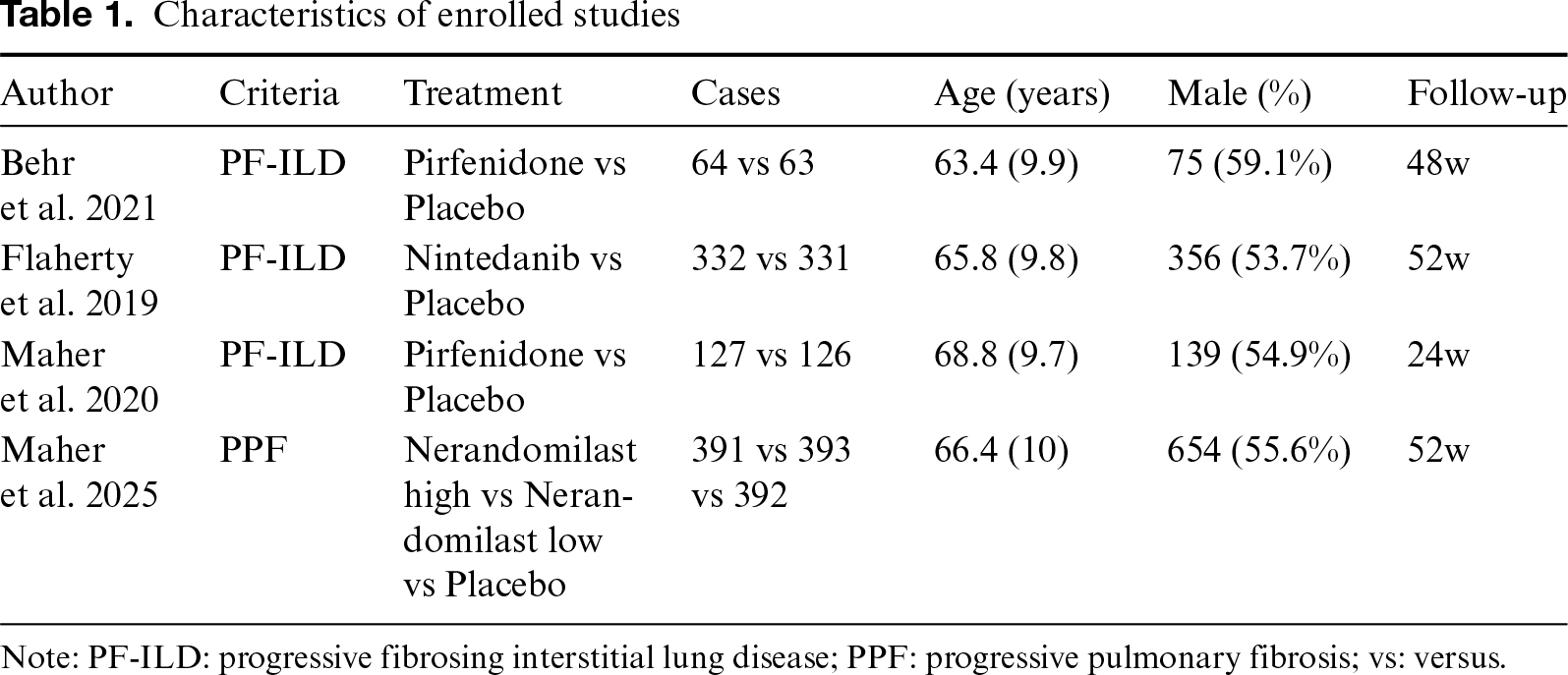
A total of 1,086 records were identified through searches conducted on PubMed, Embase, Web of Science, and the Cochrane Library. After removing 117 duplicates, 901 records were screened by title and abstract. Out of 68 full-text articles that were reviewed, 64 were excluded based on the established eligibility criteria (Fig. S1). Four RCTs were included in the final qualitative and quantitative synthesis (Table 1).12,18–20 These studies examined antifibrotic therapies in patients with PF-ILD or PPF, excluding those with IPF. The sample sizes for each treatment group ranged from 127 to 393. The average age of participants varied from 63.4 to 68.8 years, with males comprising 53.7–59.1% of the population. The interventions included pirfenidone, nintedanib, and nerandomilast at different doses. The follow-up periods for these studies ranged from 24 to 52 weeks. Nerandomilast dose groupings were pre-specified.
FVC Decline
The network graph illustrating the included studies is presented in Fig. 1A. Six treatment strategies were compared against a placebo, including low-dose nerandomilast (NRD_L), high-dose nerandomilast (NRD_H), NRD_L combined with nintedanib (NRD_LN), NRD_L combined with pirfenidone (NRD_LP), as well as monotherapies of nintedanib and pirfenidone, all aimed at reducing the decline in FVC. Direct comparisons are depicted in Fig. 2A, where NRD_LN demonstrated the greatest effect with an MD of 200 mL (95% CI: 130–270), followed by NRD_HN with an MD of 190 mL (95% CI: 120–250), and nintedanib with an MD of 110 mL (95% CI: 65–150).
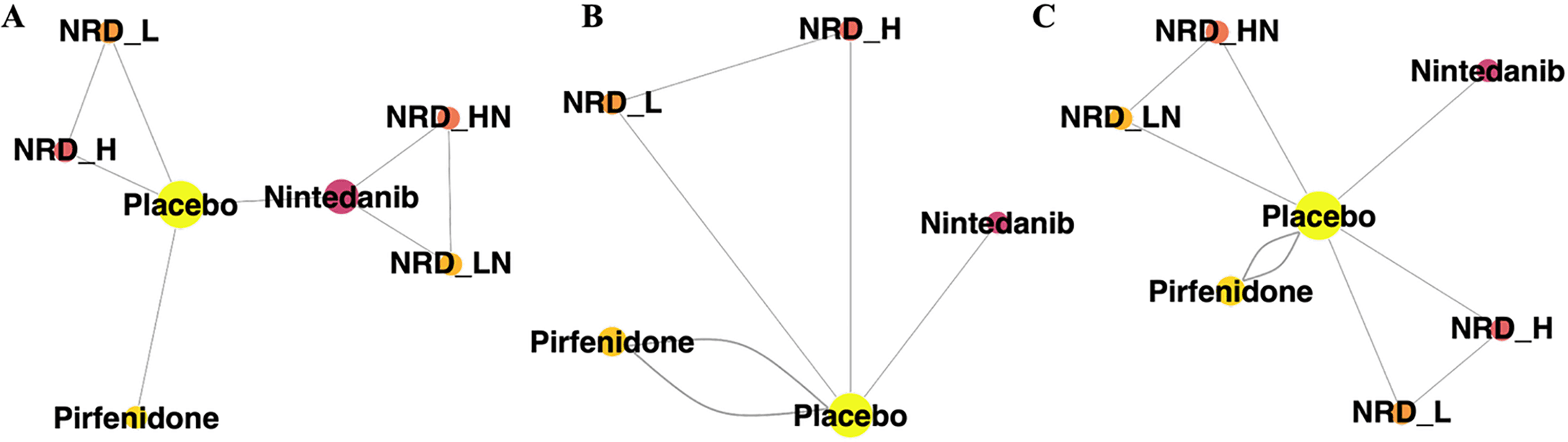
Figure 1. Network graph of enrolled studies. A: Forced vital capacity; B: all-cause mortality; C: serious adverse events; NRD_H: high-dose nerandomilast monotherapy; NRD_HN: high-dose nerandomilast combined with nintedanib; NRD_L: low-dose nerandomilast monotherapy NRD_LN: low-dose nerandomilast combined with nintedanib.
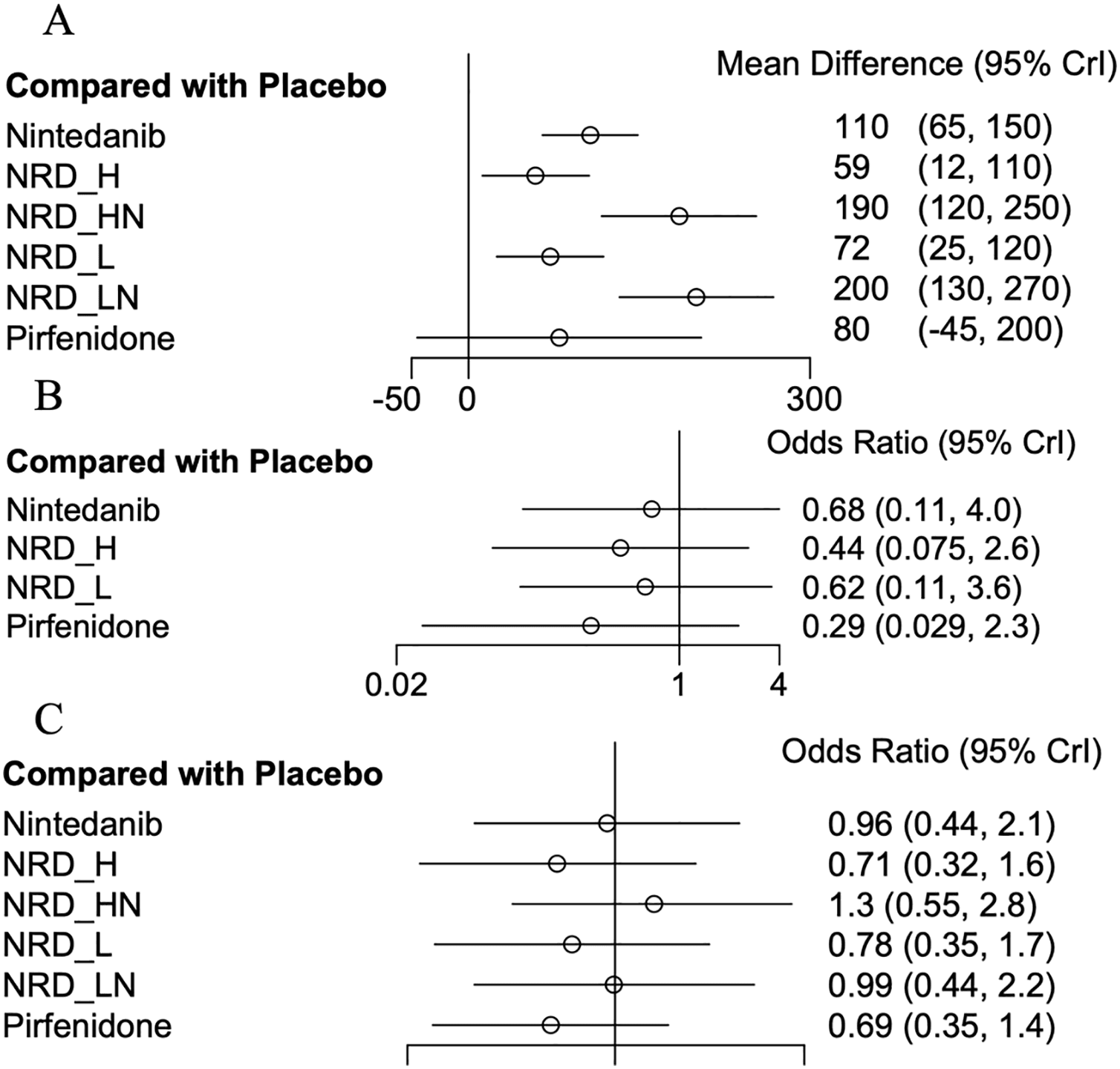
Figure 2. Direct comparison of the studies. A: Forced vital capacity; B: all-cause mortality; C: serious adverse events; NRD_H: high-dose nerandomilast monotherapy; NRD_HN: high-dose nerandomilast combined with nintedanib; NRD_L: low-dose nerandomilast monotherapy NRD_LN: low-dose nerandomilast combined with nintedanib.
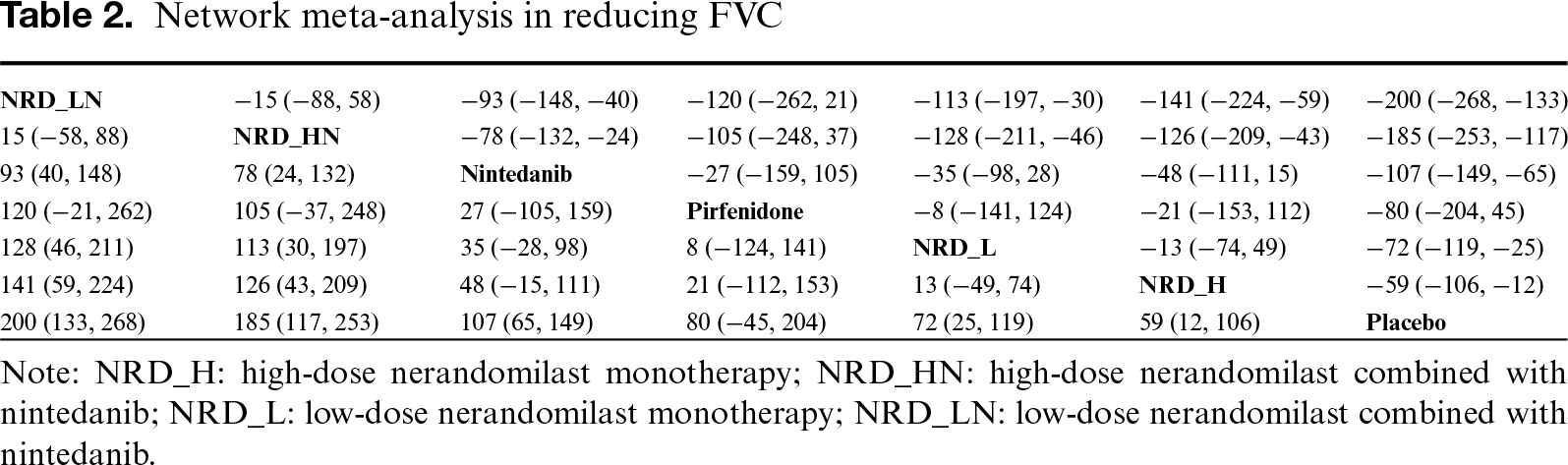
Table 2 presents a summary of the NMA results. All active treatments demonstrated greater efficacy than placebo in mitigating the decline of FVC, although the difference observed for Pirfenidone did not achieve statistical significance. The combination therapies NRD_LN and NRD_HN outperformed nerandomilast monotherapy at both low and high doses, with MDs of 128 mL (95% CI: 46–211), 141 mL (95% CI: 59–224), 113 mL (95% CI: 46–211), and 126 mL (95% CI: 43–209), respectively. Furthermore, NRD_LN and NRD_HN exhibited greater effectiveness than nintedanib, with MDs of 93 mL (95% CI: 40–148) and 78 mL (95% CI: 24–132), respectively. However, neither combination demonstrated superiority over pirfenidone monotherapy. The SUCRA-based ranking of FVC preservation (Fig. S2) identified NRD_LN (0.935) and NRD_HN (0.877) as the top-performing treatments, followed by nintedanib (0.576), pirfenidone (0.422), NRD_L (0.375), NRD_H (0.297), and placebo (0.019). Egger’s test revealed no significant publication bias (p = 0.89), and no heterogeneity was observed (I2 = 0%).
All-Cause Mortality
The network graph depicting the included studies is shown in Fig. 1B. Four treatment strategies, NRD_L, NRD_H, nintedanib, and pirfenidone, were compared with placebo in reducing all-cause mortality. Direct comparisons are presented in Fig. 2B. Pirfenidone demonstrated the most pronounced effect with an OR of 0.29 (95% CI: 0.03–2.30), followed by NRD_H (OR: 0.44; 95% CI: 0.08–2.60), NRD_L (OR: 0.62; 95% CI: 0.11–3.60), and nintedanib (OR: 0.68; 95% CI: 0.11–4.00).
Table S2 provides the log ORs from the NMA for reducing all-cause mortality. No treatment strategy demonstrated a clear advantage over the others, and none was significantly superior to placebo. The ranking of effectiveness based on SUCRA values is illustrated in Fig. S3. The SUCRA values were 0.751 for pirfenidone, 0.661 for NRD_H, 0.469 for NRD_L, 0.436 for nintedanib, and 0.183 for placebo. Egger’s test indicated no evidence of publication bias (p = 0.83), and no heterogeneity was detected (I2 = 0%).
SAEs
The network graph illustrating the included studies that evaluated SAEs is shown in Fig. 1C. Six treatment strategies, NRD_L, NRD_H, NRD_LN, NRD_HN, nintedanib, and pirfenidone, were compared with placebo. Direct comparisons are presented in Fig. 2C. Pirfenidone demonstrated the most significant effect with an OR of 0.69 (95% CI: 0.35–1.40), followed by NRD_H (OR: 0.71; 95% CI: 0.32–1.60), NRD_L (OR: 0.78; 95% CI: 0.35–1.70), nintedanib (OR: 0.96; 95% CI: 0.44–2.10), NRD_LN (OR: 0.99; 95% CI: 0.44–2.20), and NRD_HN (OR: 1.30; 95% CI: 0.55–2.80).
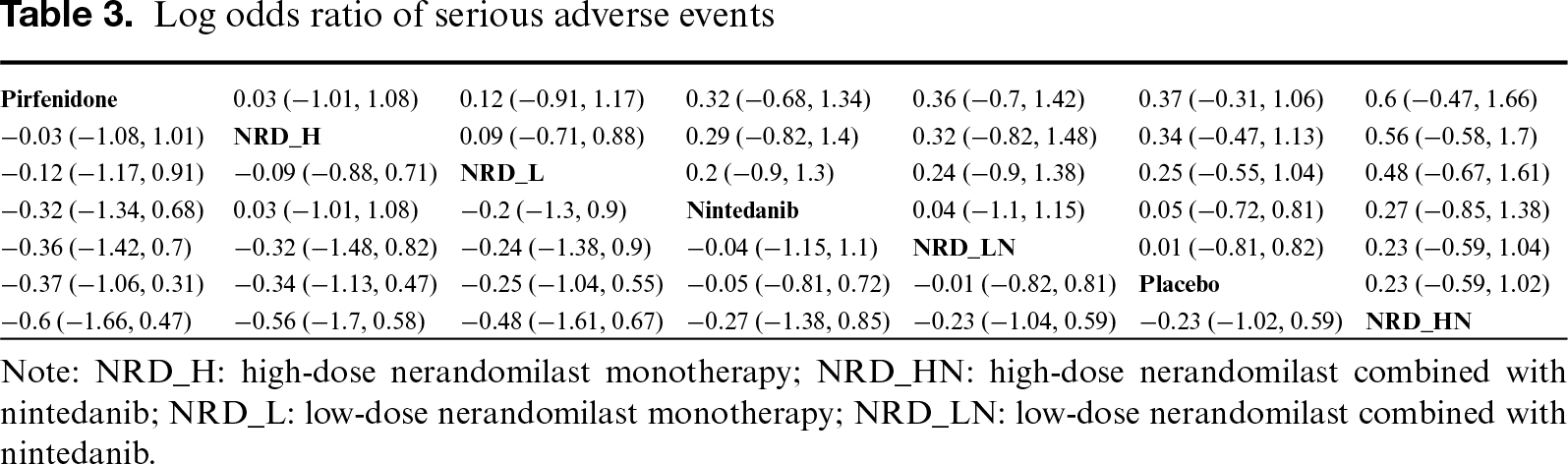
Table 3 presents the log ORs from the NMA for reducing SAEs. No treatment strategy exhibited a significant advantage over others, nor was any treatment evidently inferior to placebo. The SUCRA-based ranking of effectiveness is shown in Fig. S4. The SUCRA values were 0.740 for pirfenidone, 0.711 for NRD_H, 0.629 for NRD_L, 0.438 for nintedanib, 0.417 for NRD_LN, 0.365 for placebo, and 0.199 for NRD_HN. Egger’s test indicated no evidence of publication bias (p = 0.28), and heterogeneity was not observed (I2 = 0%).
Risk of Bias and Certainty of Evidence
One study was identified as having a high risk of bias due to incomplete outcome data and selective reporting, while another was classified as having an unclear risk of bias due to incomplete data. The remaining two studies were considered to have a low risk of bias. The certainty of evidence was rated as high for nintedanib across all outcomes, while other treatment strategies were rated as moderate, primarily downgraded due to imprecision. Overall, the findings support the efficacy of antifibrotic agents in comparison to placebo.
Discussion
This systematic review and NMA evaluated the relative efficacy and safety of oral antifibrotic therapies for patients with PPF. The analysis demonstrated that all active treatments were more effective than placebo in attenuating FVC decline, an established marker of disease progression. Among the treatments, NRD_LN, NRD_HN, and nintedanib exhibited the most substantial effects. While pirfenidone also indicated a potential benefit, it did not achieve statistical significance. Notably, NRD_LN and NRD_HN treatment regimens demonstrated superiority over nerandomilast monotherapy, suggesting that multiple therapeutic options may offer benefits in stabilizing lung function across the treatable patient demographic. These findings are consistent with previous trials that established the efficacy of nintedanib in PPF, while also offering new insights by highlighting the potential value of nerandomilast combined with existing agents.21,22 In contrast, pirfenidone’s lack of statistical significance diverges from earlier studies, possibly reflecting differences in study populations or the design of trials with small sample sizes. The inclusion of NRD-based regimens, which have not been previously synthesized in comparative analyses, represents a novel contribution to the evolving therapeutic landscape for PPF.
Regarding comparative performance, the SUCRA-based rankings revealed modest distinctions among the treatment strategies. NRD_LN and NRD_HN consistently ranked highest in preserving FVC, followed by nintedanib and pirfenidone. However, the combination therapies did not demonstrate statistical superiority over conventional monotherapies with pirfenidone. Nerandomilast monotherapy, at both low and high doses, exhibited lower potential efficacy in attenuating FVC decline compared to established monotherapies. These findings highlight the nuanced differences between monotherapy and combination regimens, emphasizing the need for further pharmacodynamic and clinical validation prior to the routine recommendation of combination antifibrotic therapies. In clinical practice, the choice of antifibrotic agent should also be guided by individual patient characteristics, comorbidities, and the tolerability profile of each drug.23
Despite the promising effects observed on lung function, none of the interventions conferred statistically significant reductions in all-cause mortality or the incidence of SAEs. Although numerical trends suggested lower mortality and SAE rates with pirfenidone and NRD_H, the wide and overlapping confidence intervals indicate substantial uncertainty. These findings highlight a common challenge in PPF: slowing physiological decline, as measured by FVC, does not necessarily equate to improved survival or reduced morbidity within the observed timeframe. FVC, while a standard endpoint in ILD trials, has limitations as a surrogate marker. It reflects changes in lung volume but may not fully capture outcomes such as quality of life, symptom burden, or extrapulmonary complications. Improvements in FVC over the short-to-medium term may not directly translate into long-term survival benefits if disease mechanisms persist. SUCRA rankings offer a probabilistic comparison of treatments and can inform clinical decision-making when interpreted alongside safety, tolerability, and patient context. However, in the absence of statistically significant pairwise differences, these rankings should be viewed cautiously, as they reflect both effect magnitude and precision rather than definitive superiority.
Several limitations warrant consideration. The analysis was limited by the small number of eligible RCTs, with only four studies meeting the inclusion criteria. These trials differed in patient populations, interventions, and sample sizes, reducing the precision of pooled estimates and the scope for meaningful comparisons. Furthermore, most had relatively short follow-up periods (24–52 weeks), which may not adequately capture longer-term outcomes such as mortality, disease exacerbations, or sustained safety signals. Additionally, one trial was identified as having a high risk of bias, and the certainty of evidence for most outcomes was downgraded due to imprecision. The reliance on indirect comparisons and the absence of head-to-head trials between specific regimens further limit the strength of comparative inferences.
Conclusion
Antifibrotic agents play a significant role in decelerating disease progression in PPF, thereby extending their established role beyond IPF. Both monotherapy and combination therapy demonstrated varying degrees of efficacy. These findings highlight the importance of individualized treatment strategies and underscore the need for future trials to directly compare agents, assess optimal sequencing or combination approaches, and incorporate patient-centered outcomes to guide long-term disease management.
Acknowledgments
None.
Funding Source
None.
Author Contributions
Y.T. contributed to the study design and drafting. Y.T. and M.K. worked on the study search, quality check, data extraction, and analysis. K.O. and H.K. worked on data interpretation and revision. All authors have read the manuscript and agree with its content and data.
Data Availability
The corresponding author shall make the datasets available upon reasonable request.
Ethical Statement
Institutional Review Board approval was waived due to the nature of the meta-analysis.
Conflict of Interest
The authors report no conflicts of interest in this work.
Supplemental Information
Supplemental information for this article can be found online at https://sup.jclinque.com/api/articles/86/download-suppl.
References
[1] Althobiani MA, Russell AM, Jacob J, et al. Interstitial lung disease: a review of classification, etiology, epidemiology, clinical diagnosis, pharmacological and non-pharmacological treatment. Front Med (Lausanne). 2024;11:1296890. doi:10.3389/fmed.2024.1296890.
[2] Maher TM. Interstitial lung disease: a review. Jama. May 21, 2024;331(19):1655–1665. doi:10.1001/jama.2024.3669.
[3] Kwon BS, Choe J, Chae EJ, Hwang HS, Kim YG, Song JW. Progressive fibrosing interstitial lung disease: prevalence and clinical outcome. Respir Res. October 31, 2021;22(1):282. doi:10.1186/s12931-021-01879-6.
[4] Raghu G, Remy-Jardin M, Richeldi L, et al. Idiopathic pulmonary fibrosis (an Update) and progressive pulmonary fibrosis in adults: an official ATS/ERS/JRS/ALAT clinical practice guideline. Am J Respir Crit Care Med. May 1, 2022;205(9):e18–e47. doi:10.1164/rccm.202202-0399ST.
[5] Mackintosh JA, Keir G, Troy LK, et al. Treatment of idiopathic pulmonary fibrosis and progressive pulmonary fibrosis: a position statement from the Thoracic Society of Australia and New Zealand 2023 revision. Respirology. February 2024;29(2):105–135. doi:10.1111/resp.14656.
[6] Olson A, Hartmann N, Patnaik P, et al. Estimation of the prevalence of progressive fibrosing interstitial lung diseases: systematic literature review and data from a physician survey. Adv Ther. February 2021;38(2):854–867. doi:10.1007/s12325-020-01578-6.
[7] Wijsenbeek M, Kreuter M, Olson A, et al. Progressive fibrosing interstitial lung diseases: current practice in diagnosis and management. Curr Med Res Opin. November 2019;35(11):2015–2024. doi:10.1080/03007995.2019.1647040.
[8] Kondoh Y, Ito T, Saito K, Bao H, Sakamoto W. Progressive pulmonary fibrosis (PPF): estimation of incidence and treatment rates in Japan using a claims database. Respir Investig. July 2024;62(4):702–709. doi:10.1016/j.resinv.2024.05.005.
[9] Aggarwal K, Arora S, Nagpal K. Pulmonary fibrosis: unveiling the pathogenesis, exploring therapeutic targets, and advancements in drug delivery strategies. AAPS PharmSciTech. July 13, 2023;24(6):152. doi:10.1208/s12249-023-02618-4.
[10] Behr J, Salisbury ML, Walsh SLF, et al. The role of inflammation and fibrosis in interstitial lung disease treatment decisions. Am J Respir Crit Care Med. August 15, 2024;210(4):392–400. doi:10.1164/rccm.202401-0048PP.
[11] Duhig EE. Usual interstitial pneumonia: a review of the pathogenesis and discussion of elastin fibres, type II pneumocytes and proposed roles in the pathogenesis. Pathology. August 2022;54(5):517–525. doi:10.1016/j.pathol.2022.05.002.
[12] Flaherty KR, Wells AU, Cottin V, et al. Nintedanib in progressive fibrosing interstitial lung diseases. N Engl J Med. 2019;381(18):1718–1727. doi:10.1056/NEJMoa1908681.
[13] Ghazipura M, Mammen MJ, Bissell BD, et al. Pirfenidone in progressive pulmonary fibrosis: a systematic review and meta-analysis. Ann Am Thorac Soc. June 2022;19(6):1030–1039. doi:10.1513/AnnalsATS.202103-342OC.
[14] Keith R, Nambiar AM. Potential of phosphodiesterase 4B inhibition in the treatment of progressive pulmonary fibrosis. Ther Adv Respir Dis. January–December 2025;19:17534666241309795. doi:10.1177/17534666241309795.
[15] Page MJ, McKenzie JE, Bossuyt PM, et al. The PRISMA, 2020 statement: an updated guideline for reporting systematic reviews. BMJ. 2021;372:n71. doi:10.1136/bmj.n71.
[16] Veroniki AA, Hutton B, Stevens A, et al. Update to the PRISMA guidelines for network meta-analyses and scoping reviews and development of guidelines for rapid reviews: a scoping review protocol. JBI Evid Synth. March 1, 2025;1(3):517–526. doi:10.11124/jbies-24-00308.
[17] University Hospital Medical Information Network. Oral Antifibrotic Agents in Pulmonary Fibrosis. Published May 2025, Accessed May 30 2025. https://center6.umin.ac.jp/cgi-open-bin/ctr_e/ctr_view.cgi?recptno=R000066310.
[18] Behr J, Prasse A, Kreuter M, et al. Pirfenidone in patients with progressive fibrotic interstitial lung diseases other than idiopathic pulmonary fibrosis (RELIEF): a double-blind, randomised, placebo-controlled, phase 2b trial. Lancet Respir Med. May 2021;9(5):476–486. doi:10.1016/s2213-2600(20)30554-3.
[19] Maher TM, Corte TJ, Fischer A, et al. Pirfenidone in patients with unclassifiable progressive fibrosing interstitial lung disease: a double-blind, randomised, placebo-controlled, phase 2 trial. Lancet Respir Med. February 2020;8(2):147–157. doi:10.1016/s2213-2600(19)30341-8.
[20] Maher TM, Assassi S, Azuma A, et al. Nerandomilast in patients with progressive pulmonary fibrosis. N Engl J Med. 2025;392(22):2203–2214. doi:10.1056/NEJMoa2503643.
[21] Raman L, Stewart I, Barratt SL, et al. Nintedanib for non-IPF progressive pulmonary fibrosis: 12-month outcome data from a real-world multicentre observational study. ERJ Open Res. March 2023;9(2):00423-2022. doi:10.1183/23120541.00423-2022.
[22] Lee JS. Progress through persistence-turning the page in pulmonary fibrosis clinical trials. N Engl J Med. May 19, 2025;392(22):2267–2269. doi:10.1056/nejme2505760.
[23] Lachowicz JA, Steinfort DP, Smallwood NE, Prasad JD. Advances in management of pulmonary fibrosis. Intern Med J. April 22, 2025;22(7):1070–1080. doi:10.1111/imj.70051.
 |
Copyright: © 2025 Tagami et al. This work is licensed under a Creative Commons Attribution 4.0 International License, which permits unrestricted use, distribution, and reproduction in any medium, provided the original work is properly cited. |