| Journal of Clinical Question. 2026; 3(2): e109 https://doi.org/10.69854/jcq.2026.0007 Advance access publication date 09 March 2026 |
 |
Original Research
Hemoglobin-to-Red Blood Cell Distribution Width Ratio and Mortality among US Adults with Diabetes or Prediabetes: A Nationwide Population-Based Cohort Study
Jinghe Li 1, Runlu Hu2, Genlong Bai2, Ye Tian1, Yun Pan2, Xinyi Shao2, Yidian Fu3,4,*, Jingbo Zhang2,*
1Guangzhou Women and Children’s Medical Center, Guangzhou Medical University, Guangzhou 510623, China.
2Department of Dermatology, The First Affiliated Hospital of Chongqing Medical University, Chongqing 400010, China.
3Graduate School of Hebei Medical University, Shijiazhuang, Hebei 050017, China.
4Department of Neurology, Hebei General Hospital, Shijiazhuang, Hebei 050051, China.
*Corresponding Authors: Y.F. e-mail: 18633072032@163.com; J.Z. e-mail: 49554556samael@gmail.com
Submitted: January 15, 2026 Accepted: March 08, 2026
Clinical Question Box
Is the hemoglobin-to-red blood cell distribution width ratio (HRR) associated with mortality in adults with diabetes or prediabetes?
In a nationally representative cohort of 18,017 US adults with diabetes or prediabetes followed for a median of 8.2 years, lower HRR was independently associated with higher risks of all-cause and cardiovascular mortality after adjustment for demographic, lifestyle, and clinical factors. The associations were nonlinear, exhibiting an L-shaped pattern, with disproportionately higher risk at low HRR levels and inflection points at approximately 1.00 for all-cause mortality and 1.08 for cardiovascular mortality.
Abstract
Background: The hemoglobin (Hb) to red blood cell distribution width (RDW) ratio (HRR) has emerged as a novel marker associated with various diseases and poor prognosis. However, its relationship with all-cause and cardiovascular mortality among individuals with diabetes or prediabetes remains unclear. Methods: This population-based prospective cohort study analyzed data from the National Health and Nutrition Examination Survey from 2001 to 2018, with mortality follow-up through 2019. All-cause and cardiovascular mortality were the primary outcomes. Weighted multivariable Cox proportional hazards models were applied to estimate hazard ratios (HRs) and 95% confidence intervals (CIs) for the association between HRR and mortality. Restricted cubic spline analyses were conducted to assess potential nonlinear relationships, and segmented Cox models were applied to estimate HRs and 95% CIs on either side of the identified inflection points. Results: This study included 18,017 US adults (≥20 years) with diabetes or prediabetes. Over a median follow-up of 8.2 years, 3,380 all-cause deaths and 1,091 cardiovascular deaths occurred. Higher HRR was independently associated with lower all-cause (HR = 0.10, 95% CI: 0.07–0.14) and cardiovascular mortality (HR = 0.08, 95% CI: 0.05–0.13). Restricted cubic spline analyses revealed L-shaped inverse associations, with inflection points at 1.00 and 1.08 for all-cause and cardiovascular mortality, respectively. The L-shaped pattern persisted among participants with diabetes, whereas a linear relationship was observed in those with prediabetes; subgroup, interaction, and sensitivity analyses confirmed these findings. Conclusions: In this national cohort study, HRR exhibited a significant L-shaped association with all-cause and cardiovascular mortality among US adults with diabetes or prediabetes. These findings suggest that HRR may serve as a promising predictor for identifying individuals at increased mortality risk in clinical practice.
Keywords: NHANES, HRR, diabetes, prediabetes, mortality
Introduction
Diabetes mellitus (DM) and its complications constitute a major global health challenge. According to the International Diabetes Federation, in 2024, approximately one in nine adults aged 20 to 79 were affected by DM worldwide, with this number projected to rise to 853 million by 2050.1 DM often remains undiagnosed for years, particularly in cases of prediabetes. The United States ranks third globally in DM prevalence, with nearly half of adults aged 65 years or older exhibiting prediabetic conditions. Diabetes is known to be associated with an elevated risk of various complications, including nephropathy, retinopathy, and neuropathy.2,3 Notably, type 2 DM (T2DM) and prediabetes are highly prevalent among patients with cardiovascular disease (CVD) and are linked to adverse outcomes.4 Despite significant advances in the treatment of heart and circulatory diseases over the past 20 years, CVD remains the leading cause of death, posing a severe risk to human health.5 Thus, identifying additional risk factors is crucial to prevent, delay, or mitigate the progression of diabetes and its related mortality.
An effective prognostic scoring system should be based on readily available, independent predictors that can be identified early at diagnosis and implemented in a cost-effective manner in clinical practice. In this context, inflammatory biomarkers derived from routine laboratory tests, such as the neutrophil-to-lymphocyte ratio and C-reactive protein, have been shown to be significantly associated with both cardiovascular and all-cause mortality in patients with T2DM.6,7 The hemoglobin (Hb)-to-red blood cell distribution width (RDW) ratio (HRR), calculated as Hb divided by RDW, has emerged as a novel inflammation-related biomarker.8 Growing evidence suggests that a lower HRR is independently associated with increased mortality and poorer prognosis across a range of conditions, including solid tumors, subarachnoid hemorrhage, sepsis-associated encephalopathy, and depression, often outperforming Hb or RDW alone.9–12
As a composite marker derived from routine tests, HRR may capture inflammatory and disease-severity signals more effectively than Hb or RDW individually. Although diabetes is widely recognized as a driver of vascular inflammation, substantial evidence also supports a central role of chronic low-grade inflammation in the pathogenesis of T2DM.13 Notably, the West of Scotland Coronary Prevention Study demonstrated that elevated C-reactive protein independently predicted future T2DM risk, regardless of body mass index (BMI), lipid levels, glycemia, or statin use.14 However, the relationship between HRR and all-cause or cardiovascular mortality among individuals with diabetes or prediabetes remains insufficiently characterized.
This study addresses existing gaps by applying a prospective cohort design based on data from National Health and Nutrition Examination Survey (NHANES) to examine the associations between HRR and all-cause and cardiovascular mortality among individuals with diabetes or prediabetes.15 The use of a large, nationally representative sample enables a comprehensive evaluation of HRR’s prognostic value for survival outcomes. Clarifying the relationship between HRR and mortality may enhance clinical decision-making and public health strategies aimed at improving risk stratification and management among diabetic and prediabetic populations. Additionally, these findings may provide a foundation for future research exploring the role of biomarkers in diabetes-related outcomes.
Materials and Methods
Study Design and Population
This cohort study utilized data from NHANES, which collects data biennially using a complex, multistage probability sampling method from the noninstitutionalized civilian population of the United States.16 As a result, the Institutional Review Board of The First Affiliated Hospital of Chongqing Medical University determined that this study was exempt from further review and that additional informed consent was not required. This study adheres to the Strengthening the Reporting of Observational Studies in Epidemiology reporting guideline.17 Data were obtained from US adults aged 20 years and older who participated in nine cycles of NHANES conducted between 2001–2002 and 2017–2018.
Definition
In NHANES, Hb (g/dL) and RDW (%) were measured in peripheral blood samples using a Coulter® DxH 800 analyzer at mobile examination centers. Detailed laboratory methodologies are available on the NHANES website. In this study, HRR was treated as a continuous independent variable. Additionally, HRR was categorized into tertiles—low (<1.01), medium (1.01–1.14), and high (≥1.14)—to evaluate its association with mortality outcomes, consistent with previous studies.18 Diabetes and prediabetes were diagnosed according to the 2021 American Diabetes Association guidelines.19
Outcomes
The primary outcome was all-cause mortality, and the secondary outcome was cause-specific mortality. Mortality data were obtained by linking NHANES records to the National Death Index using unique participant identifiers, with deaths ascertained through December 31, 2019. Causes of death were classified based on the International Statistical Classification of Diseases and Related Health Problems, Tenth Revision codes.20 Cardiovascular mortality was defined as death due to heart disease or cerebrovascular disease. Time to event was calculated from the date of the NHANES examination to the date of death or the end of follow-up, whichever occurred first.
Potential Covariates
Covariates included demographic characteristics, BMI, smoking status, alcohol consumption, and chronic diseases. Demographic variables comprised age at baseline, sex, self-reported race/ethnicity, education level, marital status, and family poverty income ratio (PIR). Chronic diseases included hypertension, diabetes, CVD, stroke, and cancer.
Age at baseline was categorized into three groups: <45 years, 45–64 years, and ≥65 years. Race/ethnicity was classified into four categories: Hispanic (Mexican American and other Hispanic), non-Hispanic White, non-Hispanic Black, and other (Asian and multiracial). Race/ethnicity was included because of its potential influence on the association between HRR and mortality. Education level was grouped as <high school, high school or equivalent, and ≥college. Family PIR was categorized as <1.3, 1.3–3.5, and ≥3.5. BMI was categorized into four groups: underweight (<18.5 kg/m²), normal weight (18.5–24.9 kg/m²), overweight (25.0–29.9 kg/m²), and obese (≥30.0 kg/m²).
Statistical Analysis
According to NHANES analytic guidelines, complex sampling design and sampling weights were considered in all analyses of our study. Participant characteristics were summarized as means (95% confidence interval [CIs]) for continuous variables and unweighted frequencies (weighted percentages) for categorical variables. Continuous data were compared using t-tests, and categorical data were compared using the χ2 test. These means and frequencies could be generalized to the US adult population.
Multivariable Cox proportional hazards regression models were conducted to estimate hazard ratios (HRs) and 95% CIs of all-cause and cardiovascular mortality associated with HRR as both a continuous variable and a categorical variable. The proportional hazards assumption was evaluated using Schoenfeld residuals. P values for trends across the three groups were also calculated. Model Ⅰ was the crude model, while Model II was adjusted for age, sex, race/ethnicity, education level, marital status, family PIR, BMI, smoking status, alcohol consumption, hypertension, diabetes, heart disease, stroke, and cancer. Subgroup analyses were conducted according to sex, age group, race/ethnicity, education level, marital status, family PIR, BMI categories, smoking status, and alcohol consumption. A stratified analysis was performed in Model II to assess the association between HRR and all-cause mortality, and interaction P values were determined using likelihood ratio tests.
Furthermore, restricted cubic spline (RCS) regressions were applied to estimate the possible nonlinearity between HRR and the risks of all-cause mortality and cause-specific mortality after adjustment for all covariates included in Model II. Additionally, we used the Kaplan–Meier survival analysis to compare all-cause and cardiovascular mortality across different HRR groups.
Finally, to assess the robustness of the association results, we conducted several sensitivity analyses: (a) excluding participants who died from accidental (unintentional injuries) causes; (b) excluding participants who died within 2 years of follow-up to reduce potential reverse causation; and (c) excluding participants with baseline CVD, stroke, or cancer. In addition, an E-value analysis was performed to quantify the minimum strength of association that an unmeasured confounder would need to have with both HRR and mortality to fully explain away the observed associations. All statistical analyses were performed using R software (version 4.4.1; R Project for Statistical Computing) and EmpowerStats (version 4.1). In all tests, a two-sided P < 0.05 was considered statistically significant.
Results
Basic Characteristics
Among 50,201 NHANES participants, 22,709 adults were identified as having diabetes or prediabetes. Participants lacking HRR-related data (n = 592), survival status (n = 39), or covariate information (n = 4,061) were excluded, yielding a final analytic sample of 18,017 participants (Fig. 1). Characteristics of excluded participants and comparisons with the analytic sample are provided in Table S1. Baseline characteristics of participants with diabetes or prediabetes (mean [SD] age, 56.8 [16.2] years; 52.9% men [weighted]; 67.0% non-Hispanic White [weighted]) stratified by HRR tertiles (low: <1.01, n = 5,985; medium: 1.01–1.14, n = 6,025; high: ≥ 1.14, n = 6,007) are summarized in Table 1.
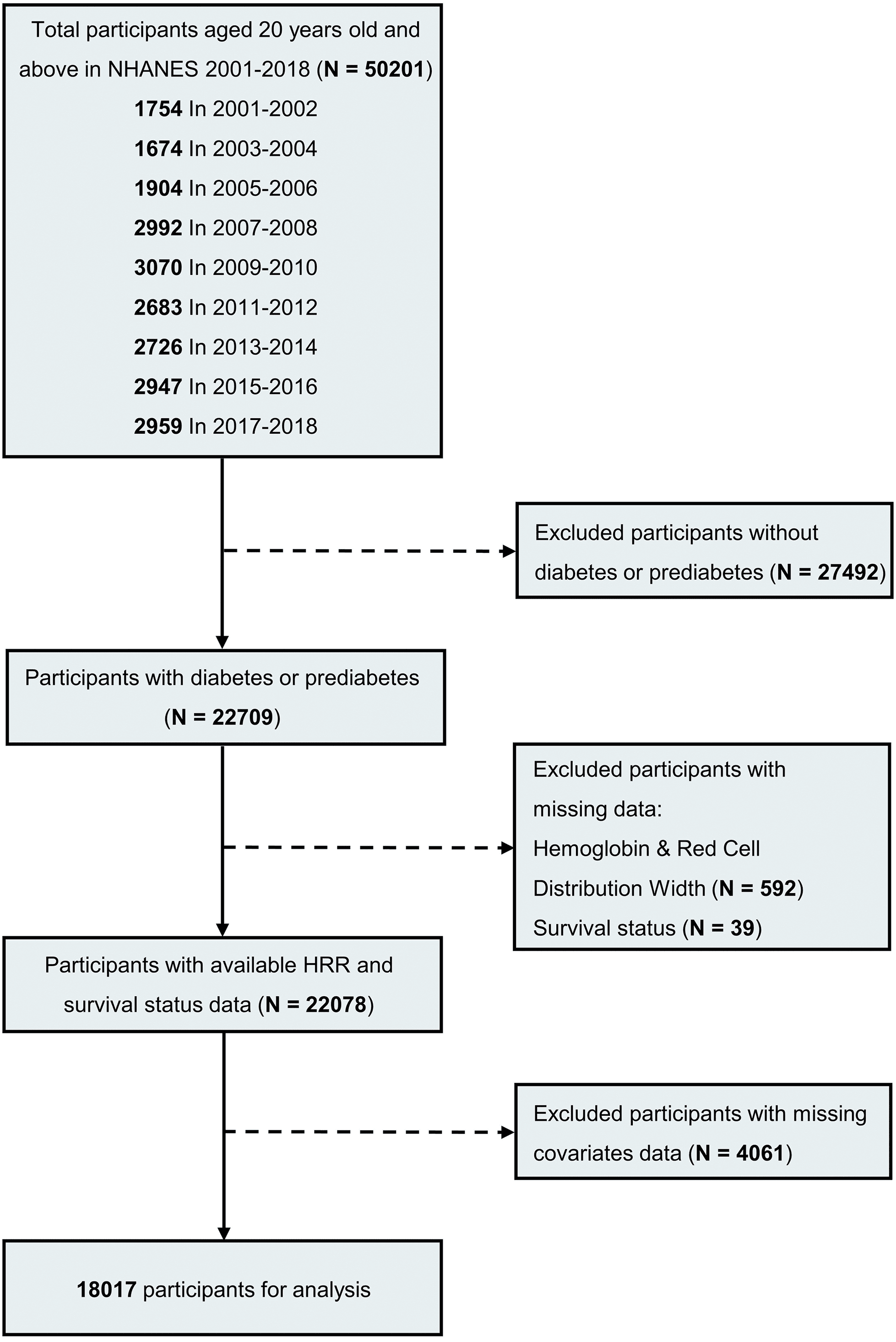
Figure 1. Flowchart of the study participants in NHANES from 2001 to 2018. NHANES, National Health and Nutrition Examination Survey; HRR, hemoglobin-to-red blood cell distribution width ratio.
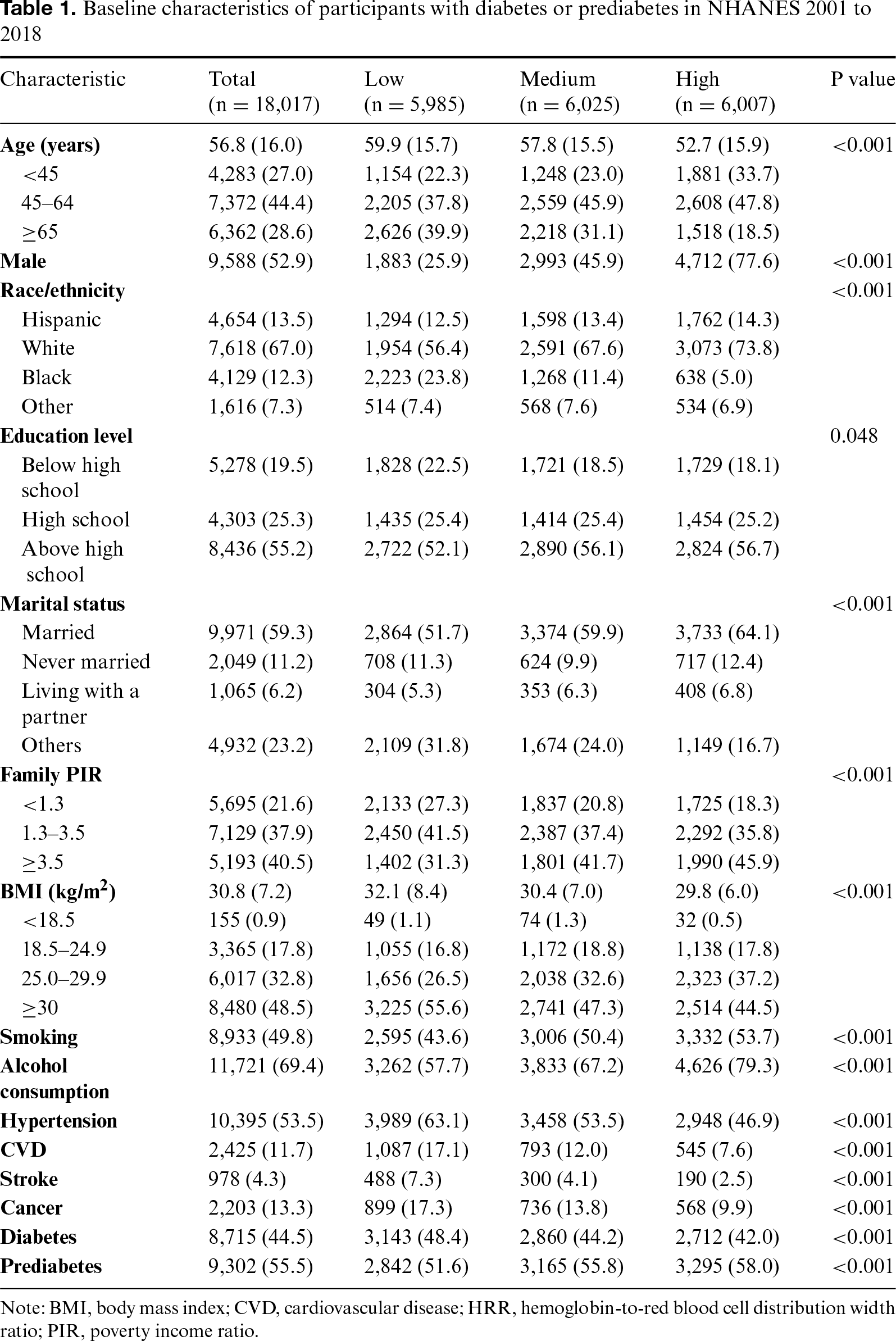
Compared with participants in the lowest HRR tertile, those in the highest tertile were younger, more often men and non-Hispanic White, had higher educational attainment, were more likely to be married, had higher family income, and had lower BMI. They were also more likely to smoke and consume alcohol, and had a lower prevalence of chronic diseases.
HRR and All-Cause and Cardiovascular Mortality
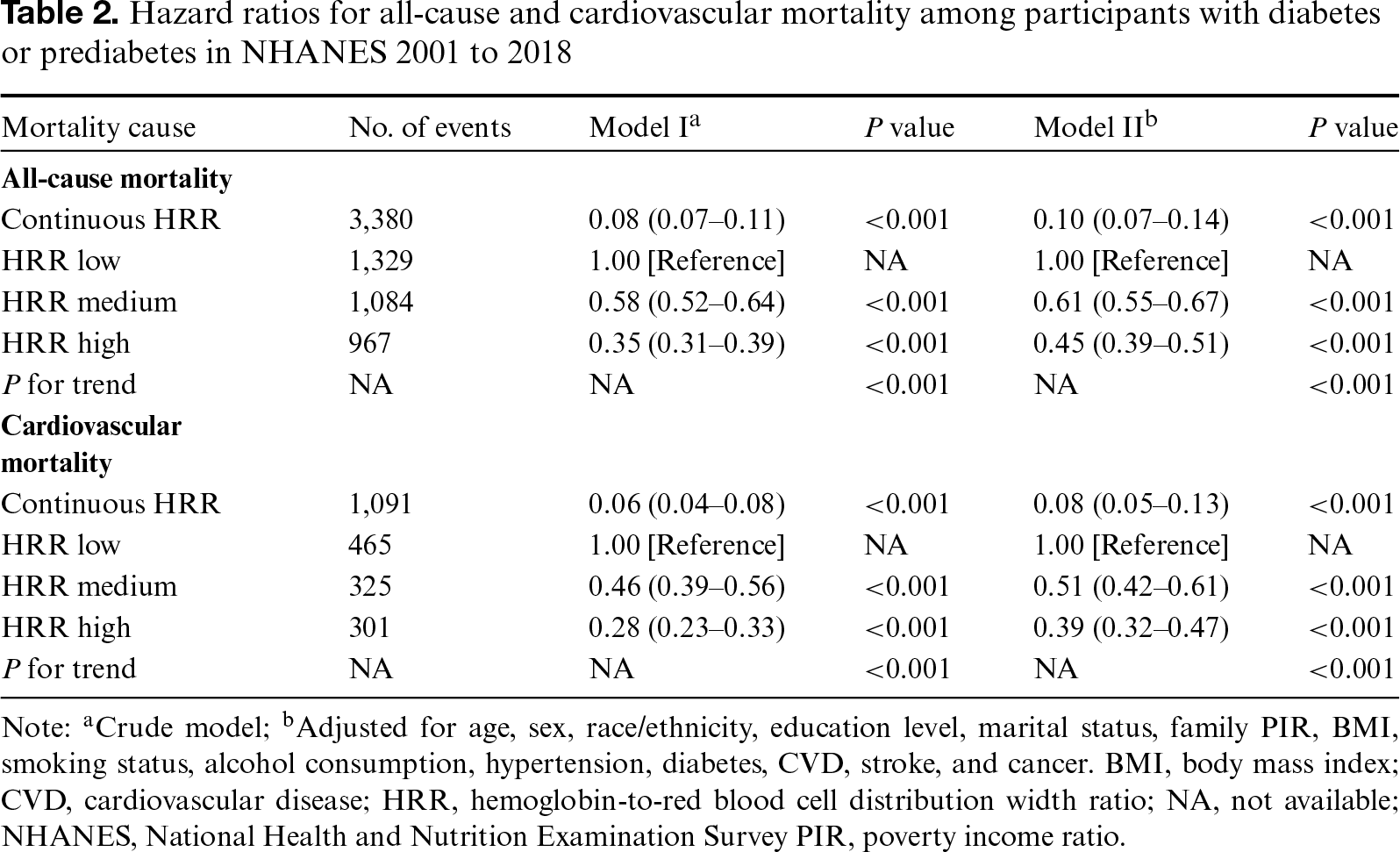
The results of Cox proportional hazards regression analyses regarding the association of HRR levels with the risk of all-cause mortality and cardiovascular mortality in participants with diabetes or prediabetes are presented in Table 2. After adjusting for all covariates (Model II), we found that elevated HRR levels were associated with a significantly lower risk of all-cause mortality (HR 0.10, 95% CI = 0.07–0.14) and cardiovascular mortality (HR 0.08, 95% CI = 0.05–0.13). Furthermore, we examined the relationship between categorized HRR levels in tertiles (low [<1.01], medium [1.01–1.14], and high [≥1.14]) and the risk of all-cause mortality and cardiovascular mortality (Table 2). Compared with participants in the low HRR group, those in the high HRR group showed significantly lower all-cause mortality risk (HR 0.45, 95% CI = 0.39–0.51) and lower cardiovascular mortality risk (HR 0.39, 95% CI = 0.32–0.47).
In addition, RCS regression was performed to further examine the dose–response relationship between HRR (as a continuous variable) and mortality. Fig. 2A and 2B demonstrate significant L-shaped (P for nonlinearity = 0.004 and 0.024, respectively) negative association between HRR and all-cause and cardiovascular mortality. Segmented Cox regression analysis identified inflection points of 1.00 and 1.08 for all-cause and cardiovascular mortality, respectively (Table S2).
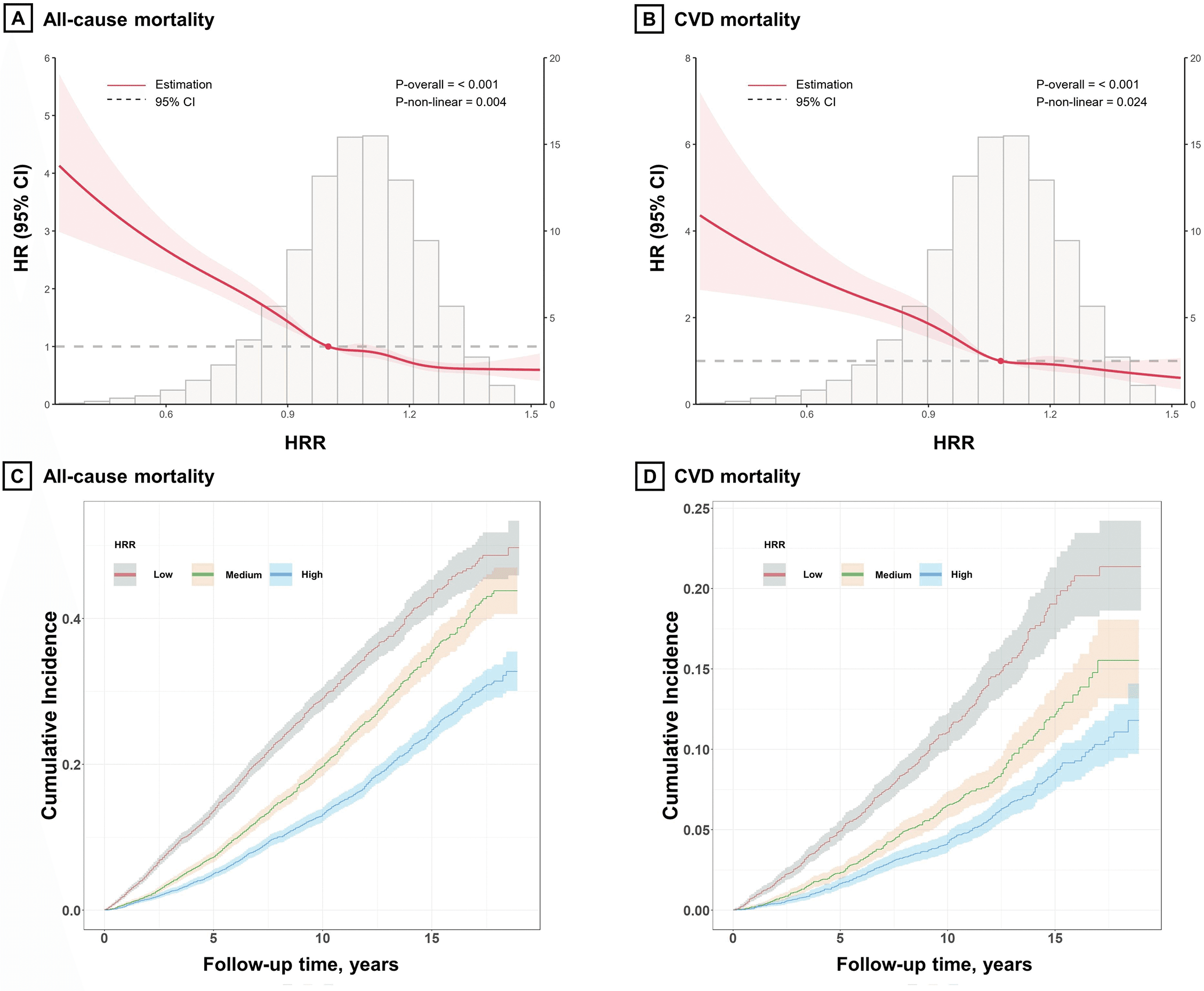
Figure 2. Association of HRR with all-cause and cardiovascular mortality among individuals with diabetes or prediabetes. RCS regression estimated HRs for all-cause (A) and cardiovascular (B) mortality across continuous HRR levels after multivariable adjustment. Cumulative incidence of all-cause (C) and cardiovascular (D) mortality was demonstrated by HRR tertiles (low <1.01, medium 1.01–1.14, high ≥1.14). Shaded areas indicate 95% CIs. CI, confidence interval; CVD, cardiovascular disease; HR, hazard ratio; HRR, hemoglobin-to-red blood cell distribution width ratio; RCS, restricted cubic spline.
We also conducted RCS regression to examine the dose–response association between HRR (as a continuous variable) and mortality in diabetic and prediabetic subpopulations, respectively (Fig. S1). The results revealed a significant L-shaped (Pfor nonlinearity = 0.001 and 0.020, respectively) negative association between HRR and all-cause and cardiovascular mortality in participants with diabetes. Interestingly, HRR exhibited no significant nonlinear (Pfor nonlinearity = 0.864 and 0.277, respectively) correlation with all-cause and cardiovascular mortality in prediabetic participants.
Moreover, Kaplan–Meier survival plots demonstrated that participants in the low HRR group experienced significantly higher cumulative risks of both all-cause and cardiovascular mortality than those in the high HRR group (Fig. 2C and 2D). Similar patterns were also observed for all-cause and cardiovascular mortality in diabetic and prediabetic populations (Fig. S1).
Subgroup and Sensitivity Analyses
A series of subgroup analyses was conducted to further assess the association between HRR levels and the risk of all-cause and cardiovascular mortality, stratified by sex, age, race/ethnicity, education level, marital status, family PIR, BMI, smoking status, and alcohol consumption. Significant interactions were identified between HRR levels and family PIR (Pfor interaction = 0.004) and smoking status (Pfor interaction = 0.03) concerning all-cause mortality (Fig. 3). Similarly, interactions were observed between HRR levels and family PIR (Pfor interaction = 0.006) and smoking status (Pfor interaction = 0.04) for cardiovascular mortality (Fig. S2). Nevertheless, the overall findings remained generally consistent across subgroups.
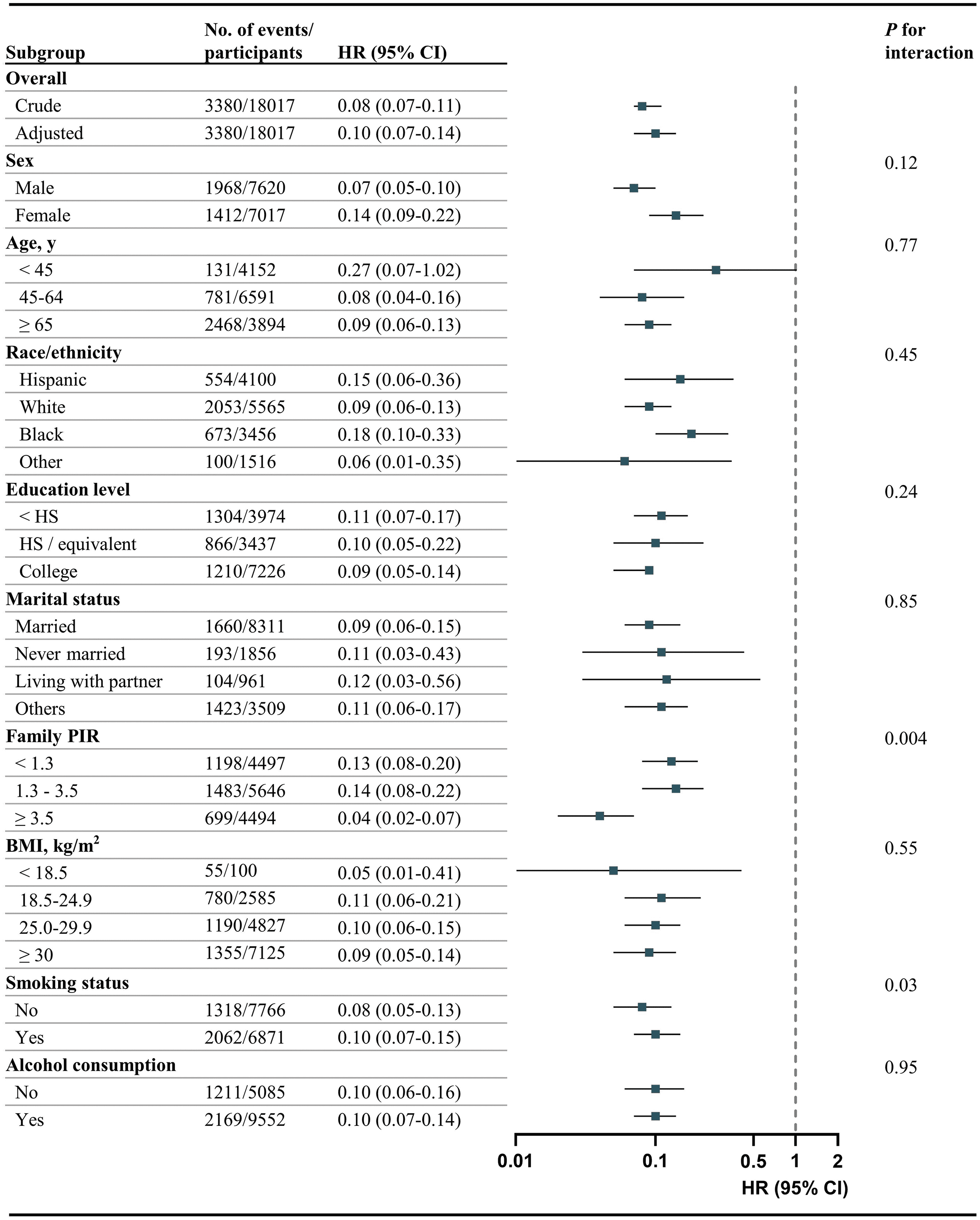
Figure 3. Associations between HRR levels and all-cause mortality among subgroups. CI, confidence interval; HR, hazard ratio; HRR, hemoglobin-to-red blood cell distribution width ratio; HS, high school; PIR, poverty income ratio.
Several sensitivity analyses were conducted to assess the robustness of the observed findings. After excluding participants who died from accidental causes, an inverse association between HRR and all-cause mortality persisted in both Model I and Model II (Table S3). Excluding participants who died within the first 2 years of follow-up yielded stable associations between HRR and the risks of all-cause and cardiovascular mortality (Table S4). Furthermore, exclusion of participants with self-reported cardiovascular disease, stroke, or cancer at baseline did not materially alter the observed associations between HRR and all-cause or cardiovascular mortality (Table S5). The E-value analysis indicated that substantial unmeasured confounding would be required to fully explain the observed associations (Table S6). For high versus low HRR, the E-values were 3.87 (95% CI limit: 3.33) for all-cause mortality and 4.57 (95% CI limit: 3.68) for cardiovascular mortality, suggesting that the results were relatively robust to unmeasured confounding.
Discussion
This study demonstrates that lower HRR levels are independently associated with higher risks of both all-cause and cardiovascular mortality among adults with diabetes or prediabetes. RCS analyses further suggest that mortality risk increases progressively as HRR decreases, with a significant L-shaped inverse association observed for both all-cause and cardiovascular mortality. Notably, no significant nonlinear association between HRR and mortality outcomes was observed in the prediabetes subgroup. Stratified and sensitivity analyses underscore the robustness of these findings. Collectively, these results suggest that HRR may represent a novel and clinically meaningful biomarker for identifying individuals with diabetes and prediabetes who are at elevated risk of mortality.
Hb, an oxygen-carrying protein abundant in red blood cells, is the primary biochemical marker used to diagnose anemia.21 Additionally, reduced Hb concentrations have been consistently linked to an increased risk of both cardiovascular and all-cause mortality.22 Notably, patients with DM may be particularly susceptible to the harmful effects of anemia, especially in the presence of CVD and hypoxia-induced organ damage.23 Anemia is a common complication of DM and has been identified as an independent contributor to the pathogenesis and progression of other diabetes-related complications.24 Previous observational studies have consistently reported that lower Hb levels are associated with a higher prevalence and greater severity of diabetic peripheral neuropathy in patients with type 2 diabetes, including elevated vibration perception thresholds.25,26 These findings suggest that anemia may contribute to nerve dysfunction and the progression of diabetes-related microvascular complications.
RDW, a parameter obtained from routine laboratory tests, reflects the degree of variation in erythrocyte volume.27 Increased RDW, often resulting from impaired erythropoiesis and abnormal red blood cell survival, has been associated with various disorders and higher mortality rates.28 Patients with diabetes tend to exhibit higher RDW than those without diabetes.29 Prior studies have demonstrated that elevated RDW is associated with both microvascular and macrovascular complications in patients with diabetes and serves as a predictor of adverse cardiovascular outcomes.30
Anisocytosis indicates a significant disruption in red blood cell homeostasis, marked by impaired erythropoiesis and reduced red blood cell survival. These dysfunctions are linked to telomere shortening, oxidative stress, poor nutrition, dyslipidemia, hypertension, and inflammation.31 Elevated RDW is associated with several biological processes, including inflammation, aging, oxidative stress, nutritional deficiencies, and impaired renal function. Low Hb levels may reflect malnutrition and impaired immune status, potentially indicating reduced tolerance to treatment. As an integrated marker of systemic inflammatory burden, HRR has the potential to serve as a valuable tool for risk stratification in diabetes patients. Given its components, RDW and Hb, HRR is both cost-effective and readily available through routine blood tests.
Although the precise biological mechanisms linking HRR and mortality are not fully elucidated, inflammation likely plays a key role. Inflammatory conditions are known to contribute to the development and progression of various diabetic complications, including diabetic nephropathy and vascular disorders.32,33 The mechanisms triggering inflammation in DM are still not fully understood. However, inflammation is believed to promote insulin resistance, which, when coupled with hyperglycemia, exacerbates the long-term complications of diabetes.34 Chronic inflammation in diabetes may lead to leukocyte recruitment to the vascular environment and oxidative stress-induced endothelial damage.35 A previous prospective cohort study involving 1,679 T2DM patients demonstrated that low-grade inflammation, measured by high-sensitivity C-reactive protein, was an independent risk factor for vascular and all-cause mortality, though not for cardiovascular events, in high-risk T2DM patients.36
Notably, endothelial function has been reported to be inversely associated with Hb levels in diabetic patients with stage 1–2 chronic kidney disease, with proteinuria acting as an effect modifier of this relationship. This observation may partially explain the observed L-shaped negative association and threshold effects observed between HRR and both all-cause and cardiovascular mortality among diabetic patients during our RCS analysis. In contrast, no significant nonlinear relationship was observed between HRR and these outcomes in the prediabetes subgroup, possibly due to the absence of diabetic nephropathy in this group.
However, several limitations of our study should be acknowledged. First, given the observational design, the associations between HRR and all-cause and cardiovascular mortality indicate correlation rather than causation. Second, the response rate of NHANES declined from 79.6% to 48.8% during 2001–2018, raising the possibility of nonresponse bias. Third, despite adjusting for potential confounders, residual confounders may still exist that could affect the results. Finally, only one-time HRR-related measurement was assessed from the participants, and their potential trajectories were not considered in the present study. Further studies incorporating multiple, repeated measurements of HRR are required to validate our findings in the future.
Conclusion
In this national prospective cohort study, we demonstrated that HRR is an independent predictor of both all-cause and cardiovascular mortality among US adults with diabetes or prediabetes. As HRR is derived from routinely available laboratory parameters, it represents a novel, practical, and potentially useful marker for mortality risk stratification in future clinical practice.
Acknowledgment
All authors thank NHANES for its open-access data.
Funding
This research was supported by Outstanding Youth Foundation of Chongqing Province (Grant Number: CSTB2024YCJH-KYXM0101); China Postdoctoral Science Foundation (Grant Number: 2024M763893). The funders had no role in the design and conduct of the study; collection, management, analysis, and interpretation of the data; preparation, review, or approval of the manuscript; and decision to submit the manuscript for publication.
Authors Contributions
J.Z. had full access to all study data and takes responsibility for data integrity and analysis accuracy. Study design: J.Z., Y.F., X.S. Data acquisition, analysis, or interpretation: J.Z., X.S., R.H. Manuscript drafting: J.Z., Y.F., Y.P., J.L., G.B., R.H. Critical revision: all authors. Statistical analysis: J.Z., Y.F., X.S. Funding acquisition: J.Z. Administrative, technical, or material support: J.Z., X.S., G.B. Supervision: J.Z., Y.F.
Availability of Data
The datasets used for these analyses are publicly available (https://www.cdc.gov/nchs/nhanes/index.htm).
Generative AI Declaration
During the preparation of this manuscript, the authors used DeepSeek to assist with proofreading. All content was subsequently reviewed and edited by the authors, who assume full responsibility for the accuracy and integrity of the published work.
Ethics Statement
We conducted a study that was exempt from institutional review since it involves secondary data analysis from the National Health and Nutrition Examination Survey.
Competing of Interests
The authors declare that they have no known competing financial interests or personal relationships that could have appeared to influence the work reported in this paper.
Supplemental Information
Supplemental information for this article can be found online at https://sup.jclinque.com/api/articles/109/download-suppl.
References
[1] Genitsaridi I, Salpea P, Salim A, et al. 11th edition of the IDF Diabetes Atlas: global, regional, and national diabetes prevalence estimates for 2024 and projections for 2050. Lancet Diabetes Endocrinol. February 2026;14(2):149–156. doi:10.1016/s2213-8587(25)00299-2.
[2] Bai P, Barkmeier AJ, Hodge DO, Mohney BG. Ocular sequelae in a population-based cohort of youth diagnosed with diabetes during a 50-year period. JAMA Ophthalmol. January 1, 2022;140(1):51–57. doi:10.1001/jamaophthalmol.2021.5052.
[3] Rooney MR, Rawlings AM, Pankow JS, et al. Risk of progression to diabetes among older adults with prediabetes. JAMA Intern Med. April 1, 2021;181(4):511–519. doi:10.1001/jamainternmed.2020.8774.
[4] Rooney MR, Wallace AS, Echouffo Tcheugui JB, et al. Prediabetes is associated with elevated risk of clinical outcomes even without progression to diabetes. Diabetologia. February 2025;68(2):357–366. doi:10.1007/s00125-024-06315-0.
[5] Woodruff RC, Tong X, Loustalot FV, et al. Cardiovascular disease mortality trends, 2010–2022: an update with final data. Am J Prev Med. February 2025;68(2):391–395. doi:10.1016/j.amepre.2024.09.014.
[6] Dong G, Gan M, Xu S, Xie Y, Zhou M, Wu L. The neutrophil-lymphocyte ratio as a risk factor for all-cause and cardiovascular mortality among individuals with diabetes: evidence from the NHANES 2003–2016. Cardiovasc Diabetol. September 29, 2023;22(1):267. doi:10.1186/s12933-023-01998-y.
[7] Gedebjerg A, Bjerre M, Kjaergaard AD, et al. CRP, C-peptide, and risk of first-time cardiovascular events and mortality in early type 2 diabetes: a danish cohort study. Diabetes Care. May 1, 2023;1(5):1037–1045. doi:10.2337/dc22-1353.
[8] Eyiol A, Ertekin B. The relationship between hemoglobin-to-red cell distribution width (RDW) ratio (HRR) and mortality in stroke patients. Eur Rev Med Pharmacol Sci. February 2024;28(4):1504–1512. doi:10.26355/eurrev_202402_35480.
[9] Zhang Y, Li H, Wang Y, Zhan S. Prognostic value of hemoglobin-to-red cell distribution width ratio in patients with thoracoabdominal aortic aneurysm: a MIMIC-IV database-based retrospective study. J Thorac Dis. August 31, 2025;17(8):6004–6016. doi:10.21037/jtd-2025-72.
[10] Li M, Li H, Zhong W, et al. Hemoglobin-to-red cell distribution width ratio was associated with cardiovascular diseases and death. J Clin Med. June 23, 2025;14(13):4464. doi:10.3390/jcm14134464.
[11] Li Y, Xu C, Qin Z, Ge L. Relationship between the hemoglobin-to-red cell distribution width ratio and in-hospital mortality in patients with chronic heart failure. Vasc Health Risk Manag. 2024;20:553–565. doi:10.2147/vhrm.S486075.
[12] Xi L, Fang F, Zhou J, et al. Association of hemoglobin-to-red blood cell distribution width ratio and depression in older adults: a cross sectional study. J Affect Disord. January 1, 2024;344:191–197. doi:10.1016/j.jad.2023.10.027.
[13] Pellegrini V, La Grotta R, Carreras F, et al. Inflammatory trajectory of type 2 diabetes: novel opportunities for early and late treatment. Cells. October 8, 2024;13(19):1662. doi:10.3390/cells13191662.
[14] Tong KI, Hopstock LA, Cook S. Association of C-reactive protein with future development of diabetes: a population-based 7-year cohort study among Norwegian adults aged 30 and older in the Tromsø Study 2007–2016. BMJ Open. September 29, 2023;13(9):e070284. doi:10.1136/bmjopen-2022-070284.
[15] National Center for Health Statistics. National Health and Nutrition Examination Survey. Published 2024, Accessed October 1 2025. https://www.cdc.gov/nchs/nhanes/about/index.html
[16] Akinbami LJ, Chen TC, Davy O, et al. National health and nutrition examination survey, 2017–March 2020 prepandemic file: sample design, estimation, and analytic guidelines. Published 2022, Accessed January 3 2026. https://stacks.cdc.gov/view/cdc/115434
[17] Dewidar O, Shamseer L, Melendez-Torres GJ, et al. Improving the reporting on health equity in observational research (STROBE-Equity): extension checklist and elaboration. Bmj. September 3, 2025;390:e083882. doi:10.1136/bmj-2024-083882.
[18] Xiong Y, Xie S, Yao Y, et al. Hemoglobin-to-red blood cell distribution width ratio is negatively associated with stroke: a cross-sectional study from NHANES. Scient Reps. November 15, 2024;14(1):28098. doi:10.1038/s41598-024-79520-x.
[19] Addendum. Classification and diagnosis of diabetes: standards of medical care in diabetes-2021. Diabetes Care 2021;44(Suppl. 1):S15–S33. Diabetes Care. Sep 2021;44(9):2182. doi:10.2337/dc21-ad09.
[20] Paleczny S, Osagie N, Sethi J, Cusimano D. Validity and reliability international classification of diseases-10 codes for all forms of injury: a systematic review. PLoS One. 2024;19(2):e0298411. doi:10.1371/journal.pone.0298411.
[21] An R, Huang Y, Man Y, et al. Emerging point-of-care technologies for anemia detection. Lab Chip. May 18, 2021;21(10):1843–1865. doi:10.1039/d0lc01235a.
[22] Li Q, Pan Z, Zeng Y, et al. Associations between hemoglobin and serum iron levels and the risk of mortality among patients with coronary artery disease. Nutrients. December 31, 2024;17(1):139. doi:10.3390/nu17010139.
[23] Wei F, Liu N, Zhang M, et al. Prognostic ability of the haemoglobin-to-red blood cell distribution width ratio in predicting in-hospital mortality: a retrospective, longitudinal, observational study among elderly patients with acute ischaemic stroke. BMJ Open. June 22, 2025;15(6):e097075. doi:10.1136/bmjopen-2024-097075.
[24] Arkew M, Asmerom H, Gemechu K, Tesfa T. Global prevalence of anemia among type 2 diabetic adult patients: a systematic review and meta-analysis. Diabetes Metab Syndr Obes. 2023;16:2243–2254. doi:10.2147/dmso.S421851.
[25] Yang J, Yan PJ, Wan Q, Li H. Association between hemoglobin levels and diabetic peripheral neuropathy in patients with type 2 diabetes: a cross-sectional study using electronic health records. J Diabetes Res. 2017;2017:2835981. doi:10.1155/2017/2835981.
[26] Zhou L, Xu X, Sheng H, Qu S, Cui R. Association between hemoglobin and diabetic peripheral neuropathy at different glycosylated hemoglobin levels in type 2 diabetes mellitus patients. Res Square. 2020;2020. doi:10.21203/rs.3.rs-16650/v1.
[27] Jiang Z, Han X, Wang Y, et al. Red cell distribution width and dementia among rural-dwelling older adults: the MIND-China study. J Alzheimers Dis. 2021;83(3):1187–1198. doi:10.3233/jad-210517.
[28] Hao M, Jiang S, Tang J, et al. Ratio of red blood cell distribution width to albumin level and risk of mortality. JAMA Netw Open. May 1, 2024;7(5):e2413213. doi:10.1001/jamanetworkopen.2024.13213.
[29] Allahyani M. Association of the red cell distribution width with the glycemic index and lipid profile in patients with type 2 diabetes mellitus. Cureus. August 2023;15(8):e42800. doi:10.7759/cureus.42800.
[30] Yoon YK, Park JH, Cho HH, et al. Red blood cell distribution width is an independent predictor of mortality following amputation for diabetic foot. Scientific Reports. February 05, 2025;15(1):4441. doi:10.1038/s41598-025-85684-x.
[31] Liu X, Wu H, Zhang S, Zhu Z, Liu C, Cao J. Higher red cell distribution width (RDW) is associated with increased all-cause and cardiovascular mortality in patients with breast cancer: a retrospective analysis of NHANES data (1999–2018). PLoS One. 2025;20(7):e0328680. doi:10.1371/journal.pone.0328680.
[32] Hou G, Dong Y, Jiang Y, et al. Immune inflammation and metabolic interactions in the pathogenesis of diabetic nephropathy. Front Endocrinol (Lausanne). 2025;16:1602594. doi:10.3389/fendo.2025.1602594.
[33] Zhao L, Hu H, Zhang L, et al. Inflammation in diabetes complications: molecular mechanisms and therapeutic interventions. MedComm (2020). April 2024;5(4):e516. doi:10.1002/mco2.516.
[34] Berbudi A, Khairani S, Tjahjadi AI. Interplay between insulin resistance and immune dysregulation in type 2 diabetes mellitus: implications for therapeutic interventions. Immunotargets Ther. 2025;14:359–382. doi:10.2147/itt.S499605.
[35] Yang DR, Wang MY, Zhang CL, Wang Y. Endothelial dysfunction in vascular complications of diabetes: a comprehensive review of mechanisms and implications. Front Endocrinol (Lausanne). 2024;15:1359255. doi:10.3389/fendo.2024.1359255.
[36] Sharif S, Van der Graaf Y, Cramer MJ, et al. Low-grade inflammation as a risk factor for cardiovascular events and all-cause mortality in patients with type 2 diabetes. Cardiovasc Diabetol. November 9, 2021;20(1):220. doi:10.1186/s12933-021-01409-0.
 |
Copyright: © 2026 Li et al. This work is licensed under a Creative Commons Attribution 4.0 International License, which permits unrestricted use, distribution, and reproduction in any medium, provided the original work is properly cited. |