| Journal of Clinical Question. 2026; 3(5): e522 https://doi.org/10.69854/jcq.2026.0028 Advance access publication date 27 October 2026 |
 |
Case Report
Germline PALB2-Mutated Triple-Negative Breast Cancer Treated with Olaparib in a Kidney Transplant Patient
Gabriel C. E. Loke, Ching Han Toh , Sherilyn Z. H. Liew, Ryan S. Y. C. Tan, Daniel J. M. Ang*
Division of Medical Oncology, National Cancer Centre Singapore, Singapore.
*Corresponding Author: e-mail: daniel.ang.j.m@singhealth.com.sg
Submitted: July 25, 2026 Accepted: October 26, 2026
Clinical Question Box
Can olaparib be considered for germline PALB2-mutated metastatic breast cancer in a kidney transplant recipient with severe kidney impairment (creatinine clearance <30 mL/min)?
In this patient, individualized reduced-dose olaparib initiated before the resumption of hemodialysis was associated with a partial response and an eight-month progression-free interval, but also with grade 3 anemia requiring transfusions and a treatment interruption. Olaparib may be considered in exceptional circumstances with close multidisciplinary monitoring, although this single case cannot establish its safety or optimal dosing in this population.
Abstract
Olaparib, a poly(ADP-ribose) polymerase inhibitor, is a commonly used agent in the treatment of human epidermal growth factor receptor 2–negative metastatic breast cancer carrying germline BRCA1/2 pathogenic variants. Phase II evidence has demonstrated antitumor activity in patients with partner and localizer of BRCA2 (PALB2) mutations. Olaparib is typically dosed at 300 mg twice daily, with a dose reduction required for a creatinine clearance (CrCl) of 31–50 mL/min. Pharmacokinetic and dosing data remain insufficient for patients with severe kidney impairment (CrCl < 30 mL/min) or kidney failure. Dose reductions are also required when olaparib is coadministered with strong or moderate CYP3A inhibitors. We describe a 47-year-old woman with recurrent metastatic triple-negative breast cancer and a failing deceased-donor kidney allograft. Multigene testing identified a germline pathogenic PALB2 c.388del variant. She received an empirical starting dose of olaparib of 150 mg twice daily because of severe kidney impairment (CrCl of 13 mL/min) and uncertainty concerning concomitant tacrolimus use. During olaparib treatment, she developed fatigue, anorexia, and grade 3 anemia requiring transfusions. The anemia prompted a six-week treatment interruption followed by individualized dose re-escalation. Her best response was a partial response according to RECIST, with a progression-free interval of eight months despite substantial hematologic toxicity. This observation cannot establish safety or an optimal dose in patients with severe kidney impairment; further pharmacokinetic and prospective clinical evidence is needed.
Keywords: olaparib, PALB2, kidney impairment, tacrolimus, case report
Introduction
Olaparib, a poly(ADP-ribose) polymerase (PARP) inhibitor, is used in the treatment of patients with metastatic breast cancer carrying germline BRCA1/2 pathogenic variants.1 Phase II evidence has demonstrated antitumor activity in patients with partner and localizer of BRCA2 (PALB2) mutations, involving a gene essential for homologous recombination repair1. PARP inhibitors stabilize PARP–DNA complexes at replication forks, resulting in replication-associated DNA damage and cell death.2
Olaparib is generally administered at 300 mg twice daily, with a recommended dose reduction to 200 mg twice daily for a creatinine clearance (CrCl) of 31–50 mL/min. Currently, there is insufficient pharmacokinetic data for its use in severe kidney impairment (CrCl < 30 mL/min) or kidney failure. Dose reductions are also required when olaparib is coadministered with strong or moderate CYP3A inhibitors.3 We describe a patient with a failing kidney allograft who was receiving tacrolimus and was treated with palliative olaparib for PALB2-mutated metastatic triple-negative breast cancer (TNBC).
Case Description
A 47-year-old woman with a history of metachronous bilateral breast cancers presented with recurrent metastatic TNBC involving the lungs, liver, and bones. At age 41, she underwent a right mastectomy and a sentinel lymph node biopsy for grade 3 TNBC (pT2N1M0), followed by adjuvant cyclophosphamide, methotrexate, and 5-fluorouracil. At age 44, she underwent a left mastectomy and a sentinel lymph node biopsy for grade 3 invasive ductal carcinoma (pT2N0M0; estrogen receptor [ER]–negative, progesterone receptor [PR]–negative, and human epidermal growth factor receptor 2 [HER2]–expressing by fluorescence in situ hybridization [FISH]), followed by adjuvant trastuzumab after declining chemotherapy. During follow-up, a chest radiograph obtained for persistent fever revealed pulmonary nodules. A biopsy confirmed metastatic breast cancer (ER-negative, PR-negative, and HER2 FISH-negative; programmed death-ligand 1 combined positive score < 1), suggesting a recurrence of the initial TNBC. Her mother had a history of ovarian cancer diagnosed at age 70.
She had received a deceased-donor kidney transplant 22 years earlier for kidney failure secondary to chronic glomerulonephritis. At the time of olaparib initiation, the allograft was failing, and CrCl was 13 mL/min. CrCl was calculated using the Cockcroft–Gault equation for women: CrCl (mL/min) = [(140 − age in years) × weight (kg) × 0.85] / [72 × serum creatinine (mg/dL)].4 She was receiving tacrolimus for immunosuppression, which is metabolized primarily via the CYP3A pathway.5
Given her metachronous breast cancers and positive family history, she consented to undergo germline genetic testing. A commercial 107-gene panel was analyzed by the Invitae laboratory in the United States. Testing identified the pathogenic PALB2 c.388del (p.Pro113Glnfs*64) variant. PALB2 is associated with autosomal dominant hereditary breast and pancreatic cancers and autosomal recessive Fanconi anemia.6
She declined chemotherapy for metastatic TNBC, consistent with her earlier decision during treatment of her left breast cancer. First-line palliative olaparib was therefore initiated at 150 mg twice daily, with subsequent dose adjustments guided by treatment-emergent adverse events. The empirical starting dose reflected her severe kidney impairment (CrCl of 13 mL/min) and uncertainty regarding potential pharmacokinetic interactions during concomitant tacrolimus therapy. Tacrolimus trough concentrations were monitored during concomitant treatment; no tacrolimus dose adjustment was required specifically in response to olaparib initiation. The numerical pretreatment and on-treatment trough concentrations were not available for reporting. During olaparib treatment, she developed grade 1 fatigue, grade 1 anorexia, and grade 3 anemia. At 11 weeks after treatment initiation, her hemoglobin level fell to 6 g/dL; the anemia was initially attributed to the failing allograft and concomitant acute-on-chronic kidney injury. However, her hemoglobin level declined further to 4.5 g/dL three months after treatment initiation despite an erythropoietin injection and a blood transfusion. Olaparib-associated anemia was suspected. Olaparib treatment was interrupted, and she was admitted for transfusion support. After the anemia improved and stabilized at grade 2, olaparib was restarted at 150 mg each morning and 100 mg each evening. Her hemoglobin level stabilized at 8–10 g/dL with this regimen. With continued stability of her hemoglobin level, the olaparib dose was gradually increased to 150 mg twice daily and then to 150 mg each morning and 200 mg each evening. No further blood transfusions were required.
During olaparib treatment, her CrCl remained below 25 mL/min due to her failing kidney allograft. She eventually required the resumption of hemodialysis due to allograft failure when immunosuppression was reduced to facilitate treatment of a chronic infection. The infection predated olaparib initiation and was not attributed to treatment-related cytopenias. She elected to continue olaparib after resuming hemodialysis, despite the limited evidence supporting its use in patients receiving hemodialysis. No further grade 3 anemia occurred despite resuming hemodialysis.
Her best response was a RECIST partial response (Fig. 1), with a progression-free interval of eight months. Cancer antigen 15-3 decreased after olaparib initiation but increased after six months of treatment (Fig. 2). The partial response was documented three months after treatment initiation, when olaparib was interrupted for six weeks because of grade 3 anemia and restarted only after the hemoglobin had stabilized.
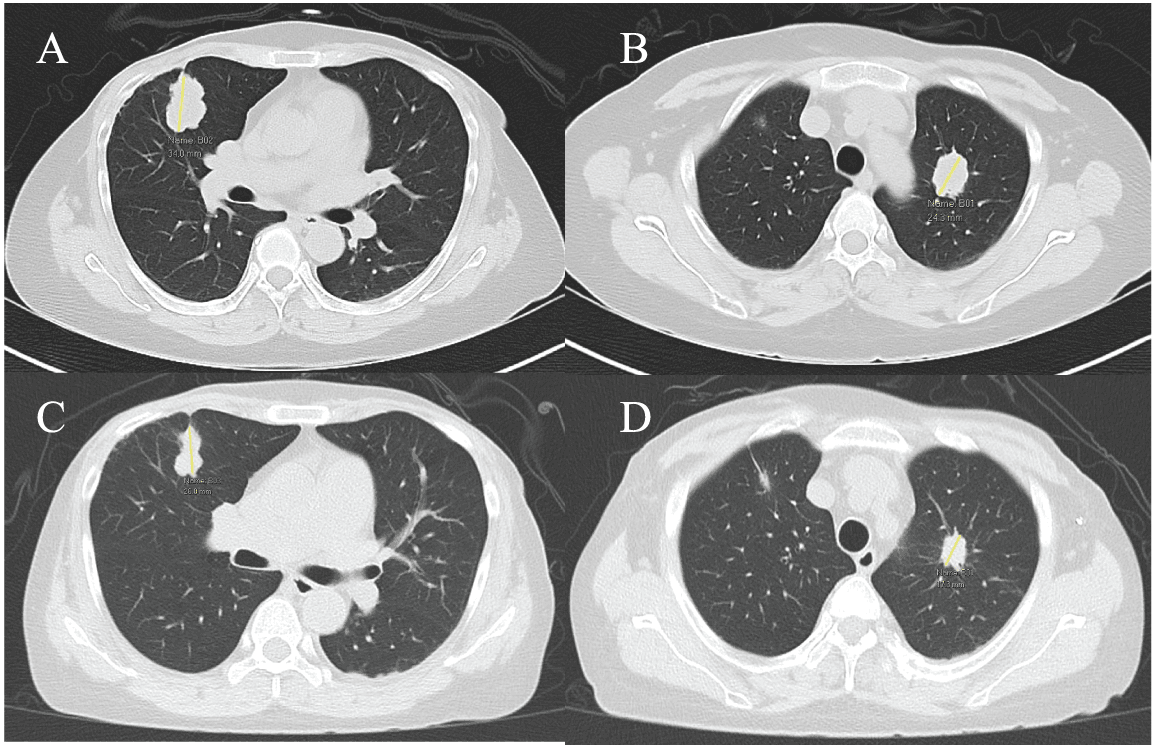
Figure 1. Thoracic computed tomography before and after olaparib initiation. A, Right middle lobe mass (34.0 mm) before olaparib treatment; B, left upper lobe mass (24.3 mm) before olaparib treatment; C, right middle lobe mass (26.0 mm) after 3 months of olaparib treatment; D, left upper lobe mass (17.3 mm) after 3 months of olaparib treatment.
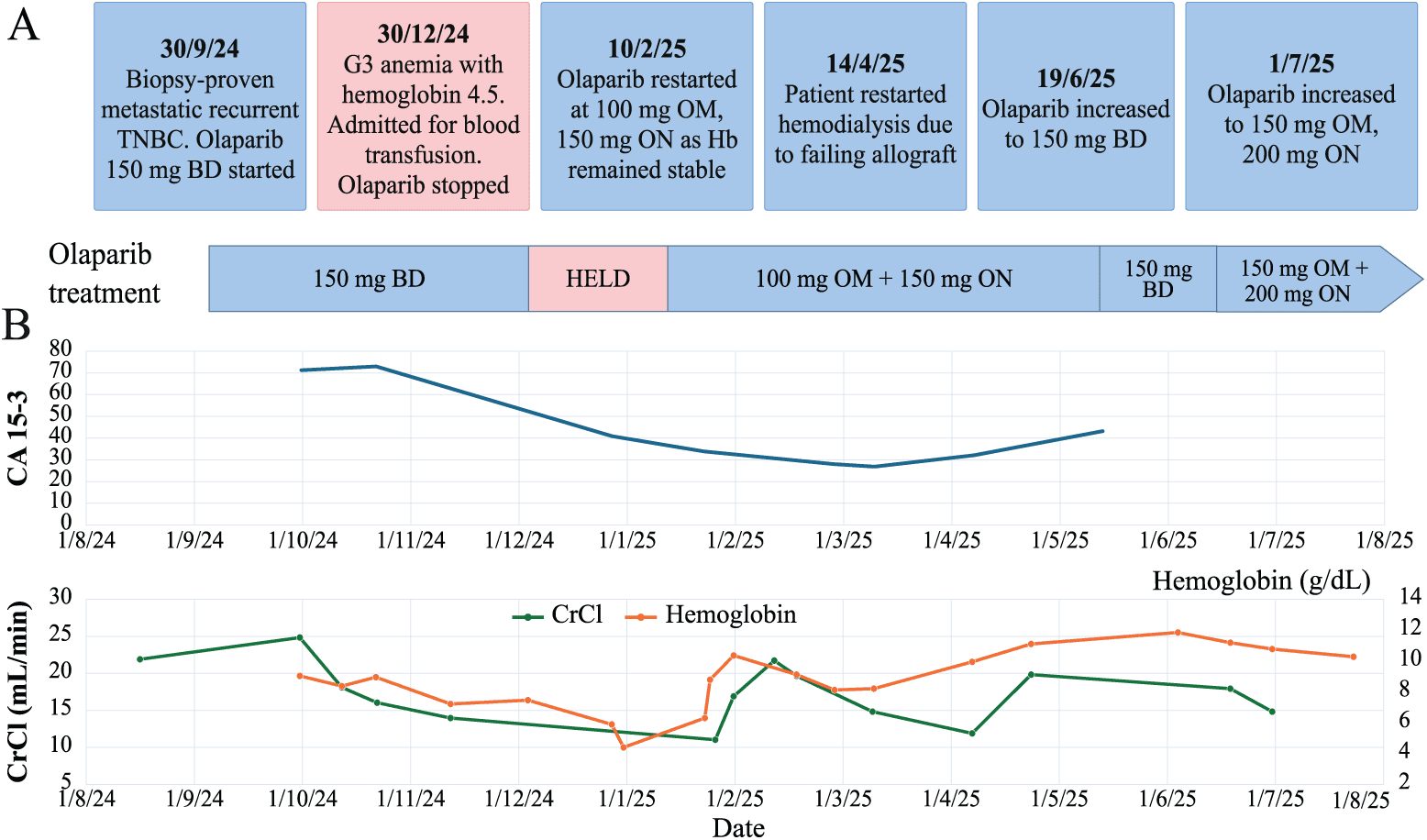
Figure 2. Integrated clinical timeline and trends in cancer antigen 15-3, creatinine clearance, and hemoglobin during olaparib treatment. A, Clinical timeline of key events and treatment; B, trends in cancer antigen 15-3, creatinine clearance, and hemoglobin during treatment.
Discussion
This case demonstrates a RECIST partial response and an eight-month progression-free interval with individualized olaparib treatment in a patient with germline PALB2-mutated metastatic TNBC and severe kidney allograft dysfunction. However, the patient developed grade 3 anemia requiring transfusions, a treatment interruption, and subsequent dose adjustments. Although allograft dysfunction may have contributed to the anemia, improvement following olaparib interruption supported a treatment-related component.
Olaparib is predominantly metabolized by CYP3A, with approximately 44% and 42% of drug-related material recovered in urine and feces, respectively, largely as metabolites.3 Compared with exposure in patients with normal kidney function, olaparib exposure increases by approximately 24% and 44% in patients with mild and moderate kidney impairment, respectively.3,7 The recommended dose is 200 mg twice daily for a creatinine clearance of 31–50 mL/min, whereas pharmacokinetic evidence remains insufficient below 30 mL/min.7 The initial dose of 150 mg twice daily was an empirical reduction rather than an established regimen. Tacrolimus is primarily a CYP3A substrate rather than an established moderate CYP3A inhibitor. Although olaparib may weakly inhibit CYP3A and potentially affect tacrolimus exposure, the reciprocal effect of tacrolimus on olaparib exposure remains uncertain.8 Tacrolimus trough concentrations were monitored without an olaparib-related dose adjustment.
Olaparib may increase serum creatinine through inhibition of tubular creatinine secretion without reducing glomerular filtration. One study reported a 14% increase in serum creatinine without significant changes in cystatin C–based filtration estimates.9 Nevertheless, true acute kidney injury has also been reported with PARP inhibitors.10 In this patient, progressive allograft dysfunction, chronic infection, and subsequent immunosuppression reduction complicate causal attribution. Without cystatin C or measured glomerular filtration rate, the contributions of pseudo-acute kidney injury and genuine kidney function deterioration could not be reliably distinguished.
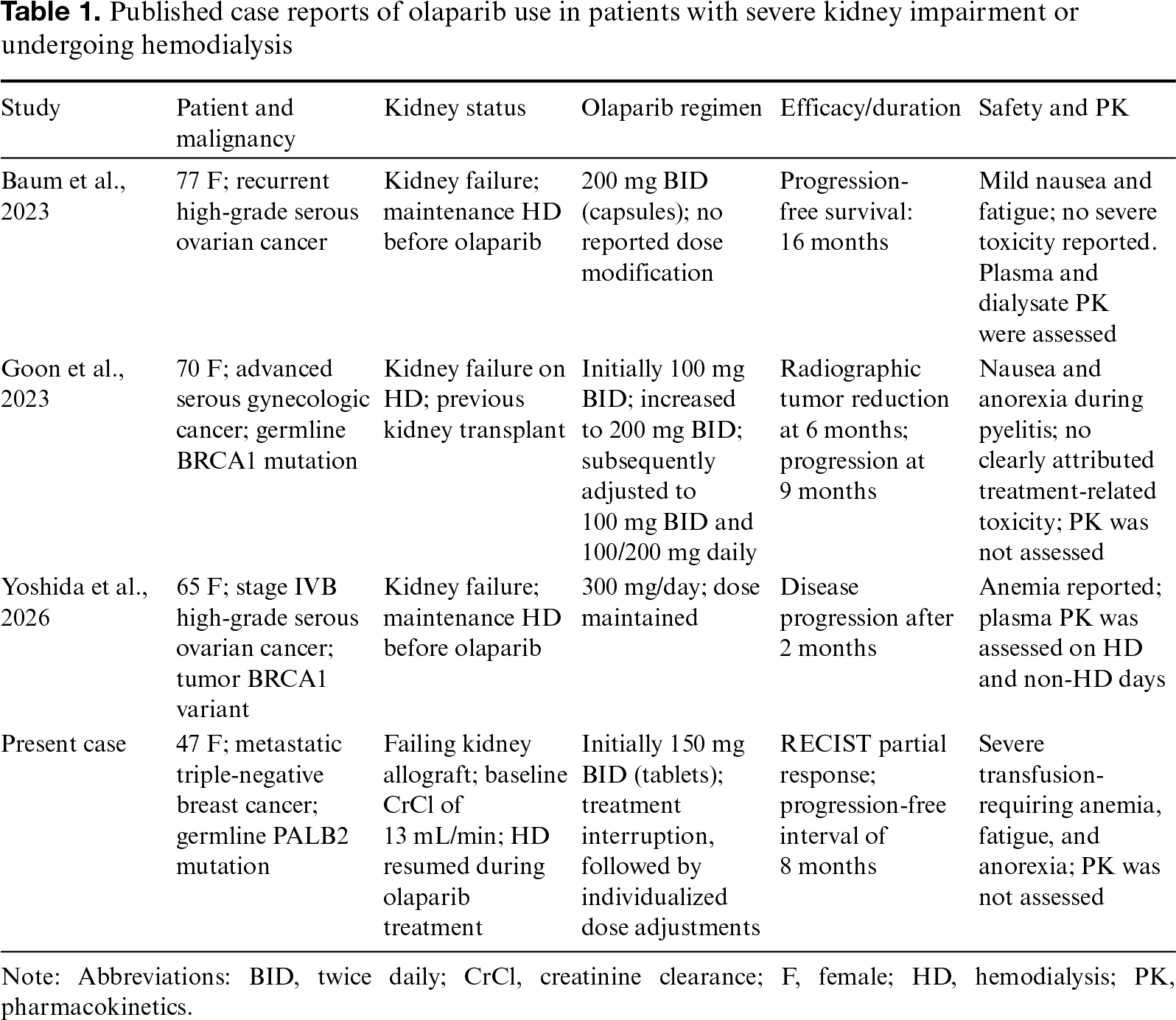
Previous reports of olaparib use in patients with severe kidney impairment have primarily involved patients already receiving hemodialysis (Table 1).11–13 Baum et al. reported prolonged disease control with pharmacokinetic assessment using the capsule formulation, whereas Goon et al. described individualized dosing without pharmacokinetic measurements. Yoshida et al. reported a pharmacokinetic assessment of the tablet formulation, accompanied by anemia and early disease progression. In contrast, our patient initiated olaparib before resuming hemodialysis. Differences in residual kidney function, dialysis status, and drug formulations limit the direct applicability of previous dosing experience to patients with severe kidney impairment who are not receiving dialysis.
Several limitations warrant consideration. Serum cystatin C was not measured, while the measured glomerular filtration rate and numerical tacrolimus trough concentrations were unavailable for reporting. Furthermore, the absence of olaparib plasma concentrations precluded an assessment of exposure–toxicity relationships. Together with the single-patient design and the complex allograft course, these limitations prevent conclusions regarding drug safety or optimal dosing. Further pharmacokinetic and clinical studies are needed to guide olaparib treatment in patients with severe kidney impairment, including those receiving hemodialysis or immunosuppressive therapy.
Conclusion
In this single kidney transplant recipient with germline PALB2-mutated metastatic TNBC and severe kidney impairment, individualized reduced-dose olaparib was associated with a RECIST partial response and an eight-month progression-free interval, but also with severe, transfusion-requiring anemia. The case suggests that treatment may be considered in exceptional circumstances with close multidisciplinary monitoring; it does not establish safety, optimal dosing, or generalizability to this population.
Acknowledgment
We thank the patient and her family for consenting to the publication of this case report.
Funding Source
This research received no external funding.
Author Contributions
L.S.Z.H., T.C.H., T.R.S.Y.C., and A.D.J.M. were part of the treating team for the patient. L.G.C.E. and A.D.J.M. worked on the analysis and interpretation of the case. All authors have reviewed and approved the final manuscript.
Data Availability
The data supporting this study’s findings are available from the corresponding author upon reasonable request.
Ethical Statement
Informed consent was obtained from the patient (SingHealth Institutional Review Board reference 2023/2173).
Conflicts of Interest
The authors report no conflicts of interest in this work.
Generative AI Declaration
Generative AI was not used in the preparation of the manuscript.
Supplemental Information
Supplemental information for this article can be found online at https://sup.jclinque.com/api/articles/131/download-suppl.
References
[1] Tung NM, Robson ME, Ventz S, et al. TBCRC 048: Phase II study of olaparib for metastatic breast cancer and mutations in homologous recombination-related genes. J Clin Oncol. December 20, 2020;38(36):4274–4282. doi:10.1200/jco.20.02151.
[2] Caulfield SE, Davis CC, Byers KF. Olaparib: a novel therapy for metastatic breast cancer in patients with a BRCA1/2 mutation. J Adv Pract Oncol. March 2019;10(2):167–174. doi:10.6004/jadpro.2019.10.2.6.
[3] Bruin MAC, Sonke GS, Beijnen JH, Huitema ADR. Pharmacokinetics and pharmacodynamics of PARP inhibitors in oncology. Clin Pharmacokinet. December 2022;61(12):1649–1675. doi:10.1007/s40262-022-01167-6.
[4] Cockcroft DW, Gault MH. Prediction of creatinine clearance from serum creatinine. Nephron. 1976;16(1):31–41. doi:10.1159/000180580.
[5] Kamdem LK, Streit F, Zanger UM, et al. Contribution of CYP3A5 to the in vitro hepatic clearance of tacrolimus. Clin Chem. August 2005;51(8):1374–1381. doi:10.1373/clinchem.2005.050047.
[6] Hofstatter EW, Domchek SM, Miron A, et al. PALB2 mutations in familial breast and pancreatic cancer. Fam Cancer. June 2011;10(2):225–231. doi:10.1007/s10689-011-9426-1.
[7] Rolfo C, de Vos-Geelen J, Isambert N, et al. Pharmacokinetics and safety of olaparib in patients with advanced solid tumours and renal impairment. Clin Pharmacokinet. September 2019;58(9):1165–1174. doi:10.1007/s40262-019-00754-4.
[8] Pilla Reddy V, Bui K, Scarfe G, Zhou D, Learoyd M. Physiologically based pharmacokinetic modeling for olaparib dosing recommendations: bridging formulations, drug interactions, and patient populations. Clin Pharmacol Ther. January 2019;105(1):229–241. doi:10.1002/cpt.1103.
[9] Bruin MAC, Korse CM, van Wijnen B, et al. A real or apparent decrease in glomerular filtration rate in patients using olaparib? Eur J Clin Pharmacol. February 2021;77(2):179–188. doi:10.1007/s00228-020-03070-0.
[10] Gupta S, Hanna PE, Ouyang T, et al. Kidney function in patients with ovarian cancer treated with poly (ADP-ribose) polymerase (PARP) inhibitors. J Natl Cancer Inst. July 6, 2023;115(7):831–837. doi:10.1093/jnci/djad070.
[11] Baum J, Zickler D, Bolbrinker J, et al. Olaparib in an ovarian cancer patient with end-stage renal disease and hemodialysis. Cancer Chemother Pharmacol. April 2023;91(4):325–330. doi:10.1007/s00280-023-04514-x.
[12] Goon KC, Alldredge J. Tolerance of olaparib in a patient with unresectable serous gynecologic cancer and end-stage renal disease. Cureus. March 2023;15(3):e36505. doi:10.7759/cureus.36505.
[13] Yoshida T, Kitamura S, Tsuda M, et al. Pharmacokinetic characterization of olaparib tablets in a hemodialysis patient with advanced ovarian cancer: a case report. Int Cancer Conf J. October 2026;15(4):612–621. doi:10.1007/s13691-026-00907-w.
 |
Copyright: © 2026 Loke et al. This work is licensed under a Creative Commons Attribution 4.0 International License, which permits unrestricted use, distribution, and reproduction in any medium, provided the original work is properly cited. |